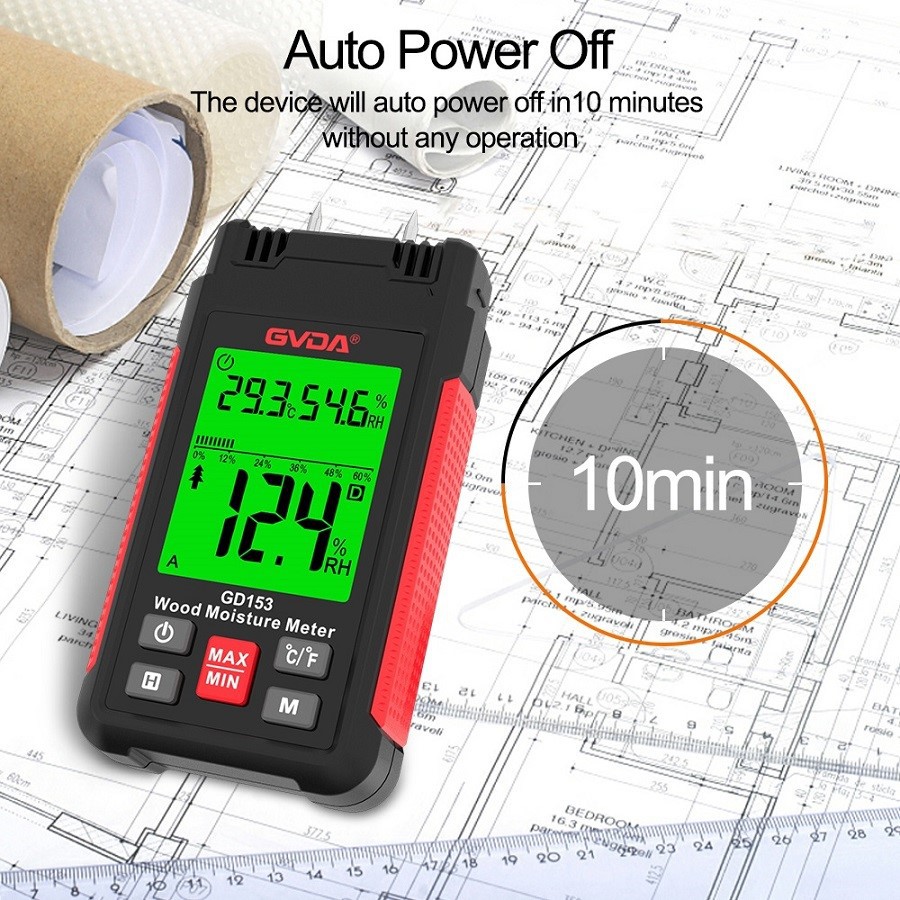
Application of Capacitive Moisture Analyzer in Building Material Testing
Principles and Characteristics
In the field of building materials, moisture content is a key parameter that affects material performance and construction quality. The capacitive moisture analyzer is based on the principle of dielectric constant measurement. By applying a high-frequency electric field between the two poles through a sensor and utilizing the polarization effect of water molecules to change the dielectric constant of the material, the moisture content can be indirectly calculated. The measurement system follows a linear relationship between the dielectric constant of the material and the moisture content, and the core formula can be expressed as:
εmix = εdry + α × W
Among them, ε mix represents the dielectric constant of the mixed medium, ε dry is the dielectric constant of the dry material, α is the material correction factor, and W is the volumetric moisture content. This formula is derived from Maxwell Garnett's mixing law and has good applicability in non-metallic building materials such as concrete, sand and gravel, wood, and insulation materials.
Instruments usually use circular or flat capacitive sensors with a working frequency range of 1 MHz to 100 MHz, which can effectively avoid ion conduction interference. During measurement, sensors are attached or inserted into the surface of the material, and the data is temperature compensated and linearly corrected by a microprocessor. Finally, the percentage of mass moisture content is output through a display module. This technology does not require contact with chemical reagents and is suitable for continuous monitoring on site. The response time is usually less than 2 seconds.
According to domestic and international standards and regulations, the capacitance method has high reliability for uniform particle materials and materials with a moisture content ranging from 0.5% to 15%. In practical use, attention should be paid to the influence of material density and salt content on dielectric properties, and if necessary, the alpha coefficient should be calibrated.
Concrete application
The water cement ratio of freshly mixed concrete is an important controlling factor for strength development during the pouring process. The capacitive moisture analyzer can be used to evaluate the moisture content of the mixture in real time, avoiding problems such as strength decrease or segregation caused by excessive water addition. Insert the probe into the surface of the mixture at a depth of 10 to 30 millimeters during operation, stabilize the reading, and adjust it based on the humidity of the raw material to obtain the effective water content.
Research has shown that different particle size distributions of aggregates can cause a deviation in the dielectric curve, and it is recommended to perform baseline calibration for each batch of aggregates. The dielectric constant of dry concrete is usually between 2 and 4, and when the moisture content increases from 1% to 6%, the ε mix can increase to 6 to 12. This nonlinear response can be fitted and corrected through polynomial regression, and a typical calibration model is as follows:
W = a0 + a1 × ΔC + a2 × ΔC2
Among them, Δ C is the change in capacitance, and a0, a1, a2 are material coefficients. This model can achieve an accuracy of ± 0.5% in engineering practice, meeting the requirements of most construction specifications.
For high-strength concrete, the capacitance signal is weak under low water cement ratio conditions, and high-sensitivity sensors need to be selected. For lightweight concrete, a higher porosity leads to more drastic changes in dielectric constant, and the calibration range needs to be expanded accordingly. During use, sensors should be avoided from coming into contact with metal molds or steel bars to prevent incorrect readings caused by electric field shielding.