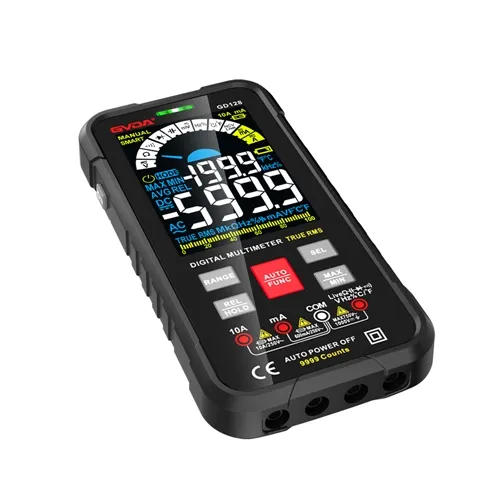
Error Analysis of Current Measurement with Multimeter
When measuring current with a multimeter, it is connected in series with the circuit being tested. The smaller the internal resistance of the ammeter, the less impact it has on the circuit, and the smaller the measurement error. In an ideal situation, the internal resistance of an ammeter should be equal to zero, but in reality it is impossible because the movable coil of a multimeter has copper wire burned paper, so there is always a certain resistance inside the meter head, called the current block internal resistance. Due to the existence of the meter head internal resistance, the total effective resistance of the measured circuit will increase when measuring the current of the multimeter current block, which changes the original working state of the measured circuit and generates measurement errors. In order to reduce measurement errors, it is required that the internal resistance of the current block itself be as small as possible. The smaller the internal resistance of the current block, the closer the measurement result is to the actual value. The error analysis during current measurement is shown in the following figure:
Error Analysis of Measuring Current with a Multimeter
a, Tested circuit; b, Connect the current mode of the multimeter
The circuit under test before the current block is connected is shown in Figure a. If the internal resistance of the power supply voltage is ignored, the current is:
In the formula, Rfz represents the load circuit.
The circuit under test shown in Figure b is connected to the DC current mode, and the loop current is:
Comparing equations 1 and 2, it can be seen that the current after connecting the current mode is not equal to the current before connecting the current mode, and the relative error is:
It can be seen that the size of Rc in the current range directly affects the measurement error, and the size of the internal resistance in the current range also affects the power loss PI of the current range:
Obviously, when the current I is constant, the larger Rc, the greater the power loss PI of the current. From the above conclusion, it can be concluded that:
1. When the full bias current is the same in the current mode, the smaller the internal resistance of the multimeter's current mode, the smaller the full bias voltage drop, and the smaller the measurement error of the current.
2. For the same multimeter, the larger the current range, the smaller its internal resistance and measurement error.
3. When the total resistance of the tested circuit is much greater than the internal resistance of the current range of the multimeter, the internal resistance of the current range of the multimeter can be ignored.
In summary, when measuring current with a multimeter, since the multimeter is connected in series with the circuit being tested, the smaller the internal resistance when selecting the current mode, the more accurate the measurement result.