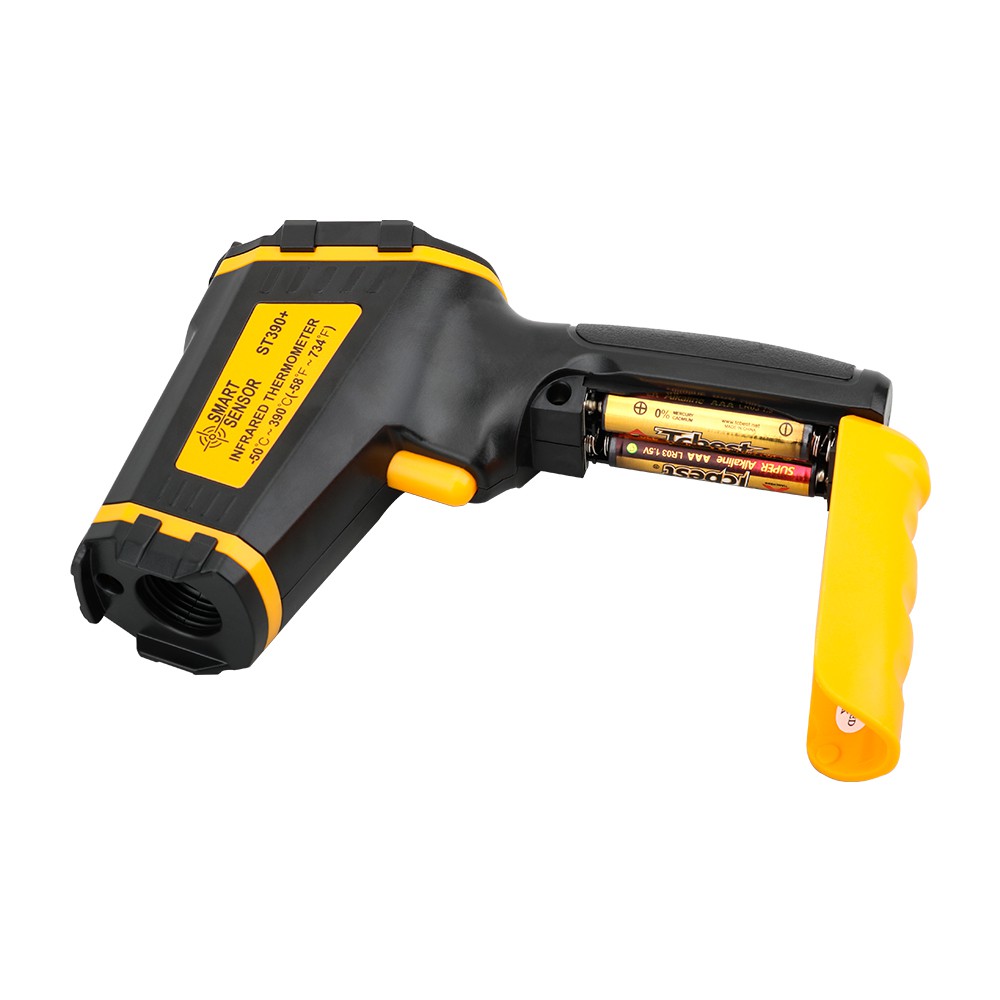
Factors Causing Inaccurate Measurements of Infrared Thermometers
Infrared temperature measurement technology plays an important role in product quality control and monitoring, online fault diagnosis and safety protection of equipment, and energy conservation in the production process. In the past 20 years, non-contact infrared human body thermometers have developed rapidly in technology, with continuously improved performance, enhanced functions, increasing varieties, and expanding applicability.
1, The relationship between the size of the temperature measurement target and the temperature measurement distance
External thermometers can be divided into monochrome thermometers and two-color thermometers (radiation colorimetric thermometers) based on their principles. For monochrome thermometers, the area of the measured target should fill the thermometer's field of view during temperature measurement. It is recommended that the size of the target being tested exceed 50% of the field of view size. If the target size is smaller than the field of view, the background radiation energy will enter the visual and acoustic symbols of the thermometer and interfere with the temperature reading, causing errors. On the contrary, if the target is larger than the field of view of the thermometer, the thermometer will not be affected by the background outside the measurement area
The effective diameter of measurable targets varies at different distances, so attention should be paid to the target distance when measuring small targets. The distance coefficient K of an infrared thermometer is defined as the ratio of the distance L of the measured target to the diameter D of the measured target, i.e. K=L/D.
2, Select the emissivity of the tested substance
1. Infrared thermometers are generally divided by blackbody (emissivity ε=1.00), but in reality, the emissivity of substances is less than 1.00. Therefore, when measuring the true temperature of the target, the emissivity value must be set. The emissivity of a substance can be found in the "Data on Object Emissivity in Radiation Thermometry".
2. Infrared thermometers cannot measure temperature through glass, which has special reflection and transmission characteristics and does not allow infrared temperature readings. But temperature can be measured through an infrared window. Infrared thermometers are not suitable for measuring temperature on bright or polished metal surfaces (such as stainless steel, aluminum, etc.).
3, Measurement of targets in strong light background
If the target being measured has bright background light (especially direct sunlight or strong lights), the accuracy of the measurement will be affected. Therefore, objects can be used to block the strong light of the direct target to eliminate background light interference.
4, Other reasons
1. Only measuring surface temperature, infrared thermometers cannot measure internal temperature. If the thermometer is suddenly exposed to an ambient temperature difference of 20 ℃ or higher, it is allowed to adjust to the new ambient temperature within 20 minutes.
2. Steam, dust, smoke, etc. It blocks the optical system of the instrument and affects temperature measurement. To avoid damaging the infrared thermometer, please first use compressed air to remove large particles and dust, and then wipe it with a cloth. Gently wipe the thermometer body with a clean and slightly damp cloth. If necessary, soak the cloth in a solution of water and a small amount of mild soap. In addition, please cover the lens of the infrared thermometer as soon as possible after use and store it in the carrying case.