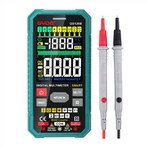
How to Detect Multimeter Leakage and Short Circuits
Preparation: Before conducting leakage measurement, it is necessary to first turn off the power switch and disconnect any equipment or power related to the circuit.
Prepare measuring leads: Ensure that the measuring leads of the multimeter are in normal condition, well connected, and not broken or damaged.
Connect the circuit: Connect the red measuring lead to the positive pole or corresponding position of the cable of the circuit under test, and connect the black measuring lead to the negative pole or corresponding position of the cable of the circuit under test.
Select measurement mode: Set the multimeter to DC current measurement mode, usually marked with the symbol 'A' or a similar symbol.
Turn on the power: Connect the power, turn on the leakage protector or switch, and let the current pass through the circuit under test.
Measurement: With the power on, gently touch the red measuring lead to the positive pole or cable end of the circuit under test, and the black measuring lead to the negative pole or cable end of the circuit under test. Observing the display of the multimeter, the recorded value is the leakage current value in the circuit under test.
Analysis result: Based on the obtained measurement results, determine whether there is a leakage problem. Generally speaking, if the leakage current value exceeds 5mA, it is considered leakage and timely measures need to be taken to repair the circuit.
Turn off the circuit and backup data: After completing the leakage test, turn off the power switch, disconnect any equipment or power related to the circuit, and backup the measurement data for future analysis.
Measurement steps for short circuit
A short circuit refers to an abnormal connection in a circuit that causes current to flow directly from the positive pole to the negative pole, bypassing normal resistors or loads, resulting in excessive current and causing faults in the circuit or equipment. A multimeter can be used to detect short circuits in a circuit.
Preparation work: Before conducting short-circuit measurement, it is also necessary to turn off the power switch and disconnect any equipment or power related to the circuit.
Prepare measuring leads: Ensure that the measuring leads of the multimeter are in normal condition, well connected, and not broken or damaged.
Connect the circuit: Connect the red measuring lead to the positive pole or corresponding position of the cable of the circuit under test, and connect the black measuring lead to the negative pole or corresponding position of the cable of the circuit under test.
Select measurement mode: Set the multimeter to DC resistance measurement mode, usually marked as Ω.
Measurement: Measure between the two ends of the circuit under test. Firstly, separate the measuring leads from the contacts of the circuit and ensure that the clean metal parts are free of impurities or gaps. Then, gently touch one end of the circuit with the red measuring lead and the other end of the circuit with the black measuring lead. Observing the display of the multimeter, the recorded value is the resistance value of the circuit under test.
Analysis result: Based on the obtained measurement results, determine whether there is a short circuit problem. Generally speaking, if the resistance value is close to or almost zero, it indicates the presence of a short circuit and requires inspection and repair of the circuit.
Turn off the circuit and backup data: After completing the short-circuit test, turn off the power switch, disconnect any equipment or power related to the circuit, and backup the measurement data for future analysis.