How to use anemometer and precautions
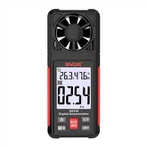
anemometer
Used in health supervision, environmental monitoring, health and epidemic prevention, university sciences, food safety, industrial pollution, heavy metal dyes, potions, chemicals, beverages, bacteria, sewage, pulp, pharmaceuticals, fermentation, electroplating, drinking water production workshops, planting, and breeding Fishing sites. Instructions, batteries, and carrying case are included to facilitate field use, quality control, health prevention, and various environmental measurements, such as factories, schools, offices, traffic roads, homes, and other measurement applications. Here's how to use an anemometer and what to note:
Instructions:
1. Observe whether the pointer of the meter points to zero before use. If there is deviation, gently adjust the mechanical adjustment screw of the meter to return the pointer to zero; 2. Set the calibration switch to the off position
3. Insert the measuring rod plug into the socket, place the measuring rod vertically upward, tighten the screw plug to seal the probe, place the "calibration switch" in the full-scale position, and slowly adjust the "full-scale adjustment" knob so that the meter pointer points to full-scale. degree position;
4. Set the "calibration switch" to the "zero position" and slowly adjust the "coarse adjustment" and "fine adjustment" knobs so that the meter pointer points to the zero point.
5. After the above steps, gently pull the screw plug to expose the measuring rod probe (the length can be selected according to your needs), and make the red dot on the probe face the wind direction. According to the meter reading, check the calibration curve to find out. Measured wind speed;
6. After measuring for several minutes (about 10 minutes), the above steps 3 and 4 must be repeated once to standardize the current in the meter.
7. After the measurement is completed, the "calibration switch" should be placed in the off position.
Precautions:
1. It is prohibited to use the anemometer in a flammable gas environment.
2. It is prohibited to place the anemometer probe in flammable gas. Otherwise, it may cause fire or even explosion.
3. Do not disassemble or modify the anemometer. Otherwise, electric shock or fire may result.
4. Please use the anemometer correctly according to the requirements of the instruction manual. Improper use may result in electric shock, fire and sensor damage.
5. During use, if the anemometer emits an abnormal smell, sound or smoke, or if liquid flows into the anemometer, please turn off the power immediately and remove the battery. Otherwise, there is a risk of electric shock, fire and damage to the anemometer.
6. Do not expose the probe and anemometer body to rain. Otherwise, there may be a risk of electric shock, fire and personal injury.
7. Do not touch the sensor part inside the probe.
8. When the anemometer is not used for a long time, please remove the internal battery. Otherwise, the battery may leak, causing damage to the anemometer.
9. Do not place the anemometer in a place with high temperature, high humidity, dust, or direct sunlight. Otherwise, it will cause damage to internal components or deterioration of anemometer performance.
10. Do not use volatile liquids to wipe the anemometer. Otherwise, the anemometer housing may be deformed and discolored. If there are stains on the surface of the anemometer, you can wipe it with soft fabric and neutral detergent.
11. Do not drop or stress the anemometer. Otherwise, it will cause the anemometer to malfunction or be damaged.
12. Do not touch the sensor part of the probe when the anemometer is powered. Otherwise, the measurement results will be affected or the internal circuit of the anemometer will be damaged.