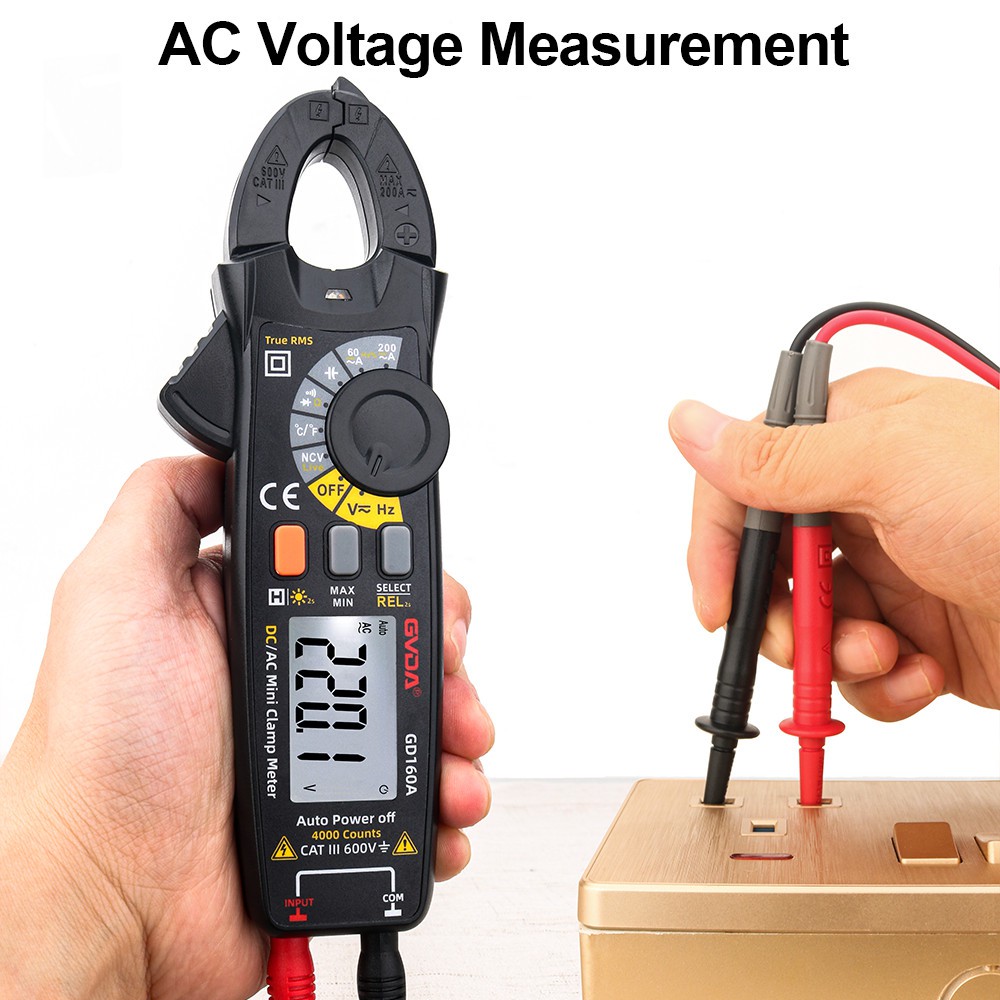
Introduction to the use and operating procedures of clamp watches
Correct use of clamp watches:
① Estimate the magnitude of the measured current and adjust the conversion switch to the desired measurement position.
If it is impossible to estimate the magnitude of the measured current, measure it using a higher range first. Then adjust to the appropriate range according to the measurement situation.
② Grasp the handle of the pliers tightly. Open the pliers and place the measured wire. To reduce errors, the measured wire should be placed in the center of the clamp mouth.
③ The jaws should be in close contact. If there is any noise, check if the jaws are clean, or open them again and close them again.
④ When measuring small currents below 5A, in order to improve measurement accuracy, if conditions permit, the measured wire can be wound a few times and then placed in a clamp for measurement. At this point, the actual current should be the instrument reading divided by the number of wire turns placed in the clamp.
⑤ When measuring a small current, the wire can be wound several turns on the clamp iron core. After closing the clamp, the reading can be taken. At this time, the current value on the wire is equal to the reading divided by the number of turns (calculation of the number of turns: there are several wires inside the clamp, even if it is a few turns).
⑥ After use, the gear should be set to a higher current gear. If there is a watch cover, it should be placed in the cover and stored in a dry, dust-free, non corrosive gas, and vibration free place.
⑦ High voltage current cannot be measured, and the voltage of the tested circuit must not exceed the rated voltage of the clamp meter. Clamp gauges cannot measure high-voltage electrical equipment.
⑧ During the measurement process, the gear cannot be switched. Before changing the gear, the wire should be removed from the jaws, and after changing the gear, it should be clamped into the jaws again for measurement;
Just in case there is an open circuit on the secondary side of the current transformer when switching gears, which may cause high voltage and endanger personal safety, as well as damage to the ammeter.
If it exceeds 1000V, it is very likely to cause damage to the multimeter. However, the upper limit of measurable voltage for different digital multimeters may vary. If the measured voltage exceeds the range, resistance voltage reduction can be used for measurement. In addition, when measuring high DC voltages ranging from 40O to 1000V, the probe must be in good contact with the measurement point without any shaking. Otherwise, in addition to causing damage to the multimeter and inaccurate measurement, it may also cause the multimeter to display no information in severe cases.
When measuring resistance, be careful not to measure it with electricity.