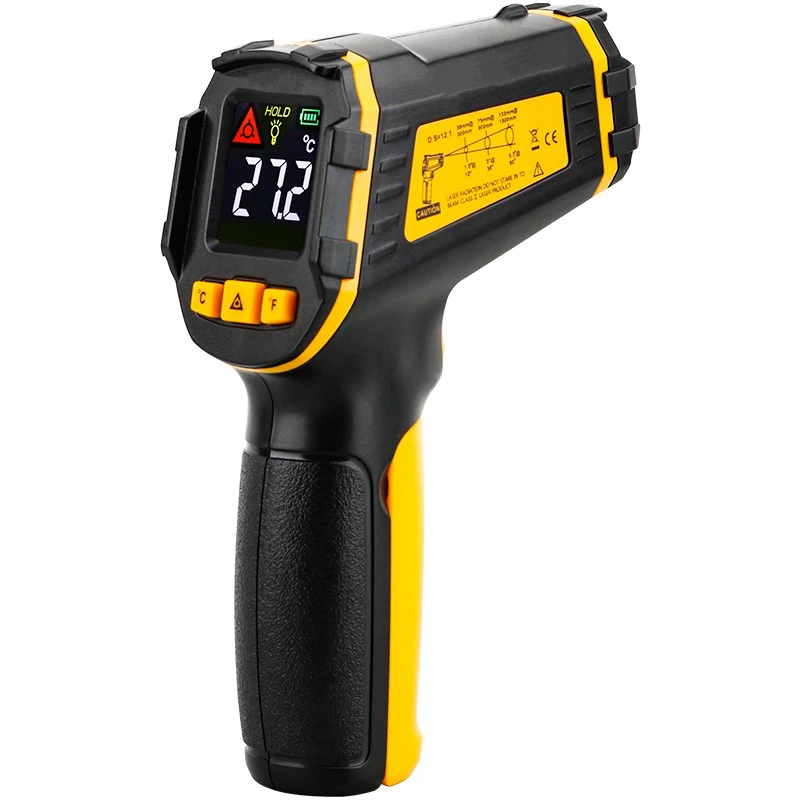
Learn the working principle of high-speed infrared thermometers
The high-speed infrared thermometer consists of an optical system, a photodetector, a signal amplifier, signal processing, display output, and other components. A high-speed infrared thermometer measures infrared radiation energy through infrared detectors (thermal detectors and photodetectors) and converts it into electrical signals, which are then converted into temperature based on the fundamental laws of radiation.
The optical system collects the infrared radiation energy of the target within its field of view, and the size of the field of view is determined by the optical components and position of the thermometer. Infrared energy is focused on the photodetector and converted into corresponding electrical signals. The signal is converted into the temperature value of the measured target after being amplified and processed by the signal processing circuit according to the internal algorithm of the instrument and the target emissivity correction. In addition, the environmental conditions of the target and thermometer, such as temperature, atmosphere, pollution, and interference, should also be considered for their impact on performance indicators and correction methods.
High speed infrared thermometers are used to measure the surface temperature of objects. The energy emitted, reflected, and transmitted by the optical components of the thermometer is focused onto the detector. The electronic components of the thermometer convert this information into temperature readings and display them on the thermometer's display panel. The temperature displayed by an infrared thermometer is often referred to as the brightness temperature of the target, which differs from the true temperature of the object because the emissivity of the object has a certain impact on radiation temperature measurement. Almost all actual objects in nature are not blackbodies. The radiation level of all actual objects depends not only on the radiation wavelength and temperature of the object, but also on factors such as the type of material, preparation method, thermal process, surface state, and environmental conditions that make up the object. Therefore, in order to make the blackbody radiation law applicable to all practical objects, a proportionality coefficient related to material properties and surface states, namely emissivity, must be introduced. This coefficient represents the degree to which the thermal radiation of an actual object is close to blackbody radiation, and its value ranges from 0 to 1. According to the law of radiation, as long as the emissivity of a material is known, the infrared radiation characteristics of any object are known