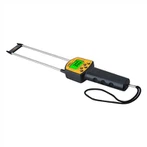
Multimeter maintenance method
1. Do not connect to DC voltage higher than 1000V or AC RMS voltage higher than 700V;
2. Do not connect the voltage source when the function switch is in the Ω and position;
3. Please do not use the watch when the battery is not installed or the back cover is not tightened.
Multimeter Repair Tips
1. Visual inspection
If it is found such as disconnection, desoldering, short circuit, broken fuse tube, burnt out components, etc., you can touch the temperature rise of the battery, resistors, transistors, and integrated blocks. You can refer to the circuit diagram to find out the reason for the abnormal temperature rise.
2. Voltage measurement method
By measuring whether the working voltage of each key point is normal, you can quickly find out the fault point, such as measuring the working voltage and reference voltage of the A/D converter.
3. Short circuit method
The method of checking the A/D converter generally adopts the short-circuit method, which is often used in repairing weak and micro-electric instruments.
4. Circuit breaking method
Disconnect the suspicious part from the whole machine or unit circuit. If the fault disappears, it means that the fault is in the disconnected circuit. This method is mainly suitable for the case of a short circuit in the circuit.
5. Measuring element method
When the fault has been reduced to one or several components, it can be measured online or offline. If necessary, replace it with a good component. If the fault disappears, it means that the component is broken.
Selection principle of multimeter
1. The reading accuracy of the pointer meter is poor, but the process of the pointer swing is more intuitive, and its swing speed range can sometimes objectively reflect the size of the measured (such as measuring the slight jitter); the reading of the digital meter is intuitive, but the process of digital change looks messy and not easy to watch;
2. There are generally two batteries in the pointer meter, one is low voltage 1.5V, and the other is high voltage 9V or 15V. Resistance file, the output current of the test pen of the pointer meter is much larger than that of the digital meter, the speaker can make a loud "da" sound with the R×1Ω file, and the light-emitting diode (LED) can even be lit with the R×10kΩ file;
3. In the voltage range, the internal resistance of the pointer meter is relatively small compared with the digital meter, and the measurement accuracy is relatively poor. In some high-voltage and micro-current occasions, it is even impossible to measure accurately, because its internal resistance will affect the circuit under test (such as When measuring the acceleration stage voltage of a TV picture tube, the measured value will be much lower than the actual value), the internal resistance of the voltage file of the digital meter is very large, at least in the megohm level, which has little influence on the circuit under test, but the output impedance is extremely high It is susceptible to the influence of induced voltage, and the measured data may be false in some occasions with strong electromagnetic interference;
4. In short, pointer meters are suitable for the measurement of analog circuits with relatively high current and high voltage, such as TV sets and audio amplifiers. It is suitable for digital meters in the measurement of low-voltage and low-current digital circuits, such as BP machines, mobile phones, etc. It is not absolute, and pointer tables and digital tables can be selected according to the situation.