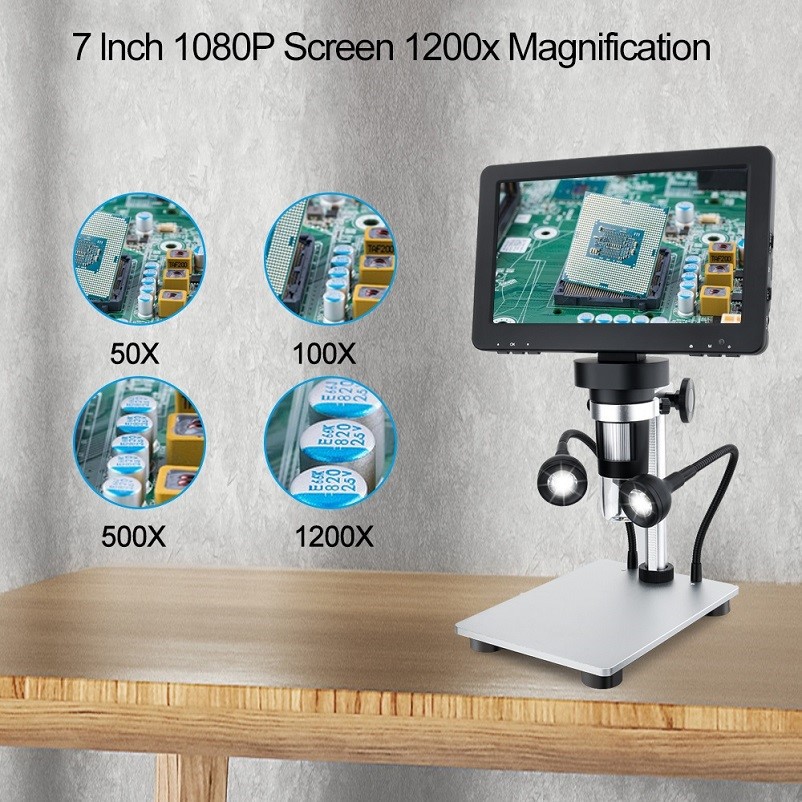
Principles and Test Influence Factors of Super Depth-of-Field Microscopes
1. Objective lens system
The objective lens of the ultra depth microscope has the characteristics of long working distance and low magnification fluctuation, which can accurately capture the microscopic details of different depth levels of the sample without changing the sample position. Compared with traditional microscope objectives, its depth of field range is significantly expanded, which can clearly present the complete structure from the sample surface to a specific depth within the same field of view, greatly reducing the image blurring problem caused by depth changes during the focusing process, and providing basic support for multidimensional observation.
2. Image fusion algorithm
When scanning and imaging the sample, the super depth of field microscope continuously acquires sequence images of different focal planes. The image fusion algorithm will perform fine analysis and processing on this series of images, accurately screen the clearest frames in each region, and then fuse them into a complete image with super depth of field effect through seamless stitching and fusion technology. With the help of this technology, the final image presented can clearly reproduce the three-dimensional microstructure of the sample, allowing observers to intuitively experience the complex morphology and exquisite details of the microstructure.
The test results of a super depth of field microscope are influenced by multiple factors, which can be mainly classified into three categories: sample characteristics, optical system parameters, and environmental factors. Targeted regulation is needed to ensure imaging quality.
1. Sample characteristics
Surface roughness: When the surface roughness of the sample is high, it is easy to cause light scattering, resulting in a decrease in image clarity and contrast. For samples with excessively high surface roughness, appropriate surface treatment such as grinding, polishing, etc. should be carried out in advance to reduce scattering interference and optimize imaging effects.
Color and Transparency: Dark or opaque samples may have insufficient imaging brightness due to light absorption; Transparent samples are prone to image distortion due to refraction and reflection. For such samples, the imaging effect can be optimized by adjusting the light source intensity, selecting special lighting modes (such as dark field lighting), or implementing staining treatment.
2. Optical system parameters
Objective selection: Different magnification objectives have their own emphasis on depth of field and resolution. Low magnification objective lenses have a deep field of view but lower resolution, while high magnification objective lenses have a high resolution but shallow depth of field. The objective lens should be selected reasonably based on the testing objectives and sample characteristics, and if necessary, observation information at different levels of the sample can be obtained by switching the objective lens.
Light source intensity and wavelength: Light source intensity directly affects image brightness, and too high or too low can affect imaging quality. Different wavelengths of light exhibit varying levels of penetration and resolution: blue light has high resolution and is suitable for surface observation; Red light has strong penetration and is suitable for imaging deep structures. The light source parameters need to be precisely adjusted according to specific needs.
3. Environmental factors
Vibration: During the operation of a super depth of field microscope, external vibrations can cause slight displacement between the sample and the objective lens, resulting in image blurring or ghosting. It is recommended to place the microscope on a stable shock-absorbing workbench and install professional shock-absorbing devices as needed to isolate vibration interference.