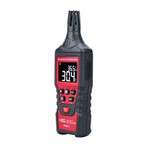
The structure of the multimeter
The multimeter is composed of three main parts: meter head, measuring circuit and changeover switch. The multimeter is the most basic tool in the field of electronic testing, and it is also a widely used testing instrument. Multimeters are also called multimeters, three-purpose meters (A, V, Ω are current, voltage, and resistance), multimeters, and multimeters. Multimeters are divided into pointer multimeters and digital multimeters. There is also a multimeter with oscilloscope function. The oscilloscope multimeter is a multi-functional, multi-range measuring instrument. General multimeters can measure DC current, DC voltage, AC voltage, resistance and audio level, etc., and some can also measure AC current, capacitance, inductance, temperature and some parameters of semiconductors (diodes, triodes). Digital multimeters have become mainstream and have replaced analog meters. Compared with analog instruments, digital instruments have high sensitivity, high precision, clear display, strong overload capacity, easy to carry, and more convenient and simple to use.
header
The head of the multimeter is a sensitive galvanometer. The dial on the head is printed with various symbols, scale marks and values. The symbol A-V-Ω indicates that the ammeter is a multimeter that can measure current, voltage and resistance. There are multiple scale lines printed on the dial, among which the one marked with "Ω" on the right is the resistance scale line, the right end is zero, the left end is ∞, and the scale value distribution is uneven. The symbol "-" or "DC" means direct current, "~" or "AC" means alternating current, and "~" means the scale line shared by AC and DC. Several rows of numbers under the scale line are the scale values corresponding to the different positions of the selector switch.
There is also a mechanical zero position adjustment knob on the meter head to correct the zero position of the pointer at the left end.
switch
The selection switch of the multimeter is a multi-position rotary switch. Used to select measurement items and ranges. General multimeter measurement items include: "mA"; DC current, "V (-)": DC voltage, "V (~)": AC voltage, "Ω": resistance. Each measurement item is divided into several different ranges for selection.
Test lead and test lead jack
The test leads are divided into red and black. When in use, insert the red test lead into the jack marked "+", and insert the black test lead into the jack marked "-".
Meter (pointer type)
It is a high-sensitivity magnetoelectric DC ammeter. The main performance indicators of the multimeter basically depend on the performance of the meter head. The sensitivity of the meter head refers to the DC current value flowing through the meter head when the pointer of the meter head is deflected at full scale. The smaller the value, the higher the sensitivity of the meter head. The greater the internal resistance when measuring voltage, the better its performance. There are four scale lines on the meter head, and their functions are as follows: the first line (from top to bottom) is marked with R or Ω, which indicates the resistance value. When the switch is in the ohm block, read this scale line. The second bar is marked with ∽ and VA, indicating the AC, DC voltage and DC current value. When the transfer switch is in the AC, DC voltage or DC current gear, and the range is in a position other than AC 10V, read this scale Wire. The third line is marked with 10V, which indicates the AC voltage value of 10V. When the switch is in the AC and DC voltage range and the range is at AC 10V, read this scale line. The fourth bar, labeled dB, indicates the audio level.
Meter (digital)
The head of a digital multimeter is generally composed of an A/D (analog/digital) conversion chip + peripheral components + liquid crystal display. The accuracy of the multimeter is affected by the head. The number converted by the A/D chip is generally also called For 3 1/2 digit multimeter, 4 1/2 digit multimeter and so on. The most commonly used chips are ICL7106 (3 and a half LCD manual range classic chip, the subsequent version is 7106A, 7106B, 7206, 7240, etc.), ICL7129 (4 and a half LCD manual range classic chip), ICL7107 (3 and a half LED manual range Classic chip).
Measuring line
The measurement circuit is a circuit used to convert various measured objects into tiny DC currents suitable for meter measurement. It is composed of resistors, semiconductor components and batteries.
It can convert various measured objects (such as current, voltage, resistance, etc.) and different ranges into a certain amount of tiny DC current through a series of processing (such as rectification, shunting, voltage division, etc.) gauge to measure.
transfer switch
Its function is to select various measurement lines to meet the measurement requirements of different types and ranges. The transfer switch is generally a circular dial with function and range marked around it.