Two working modes of anemometer
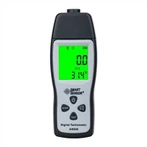
An anemometer is a speed measuring instrument that converts the flow velocity signal into an electrical signal, and can also measure the temperature or density of the fluid. The principle is that a thin metal wire heated by electricity (called a hot wire) is placed in the airflow, the heat dissipation of the hot wire in the airflow is related to the flow velocity, and the heat dissipation causes the temperature change of the hot wire to cause a change in resistance, and the flow velocity signal is transformed into electric signal. It has two working modes:
①Constant flow type.
The current through the hot wire remains constant, and when the temperature changes, the resistance of the hot wire changes, so the voltage at both ends changes, and thus the flow rate is measured;
②Constant temperature type.
The temperature of the hot wire remains constant, such as 150°C, and the flow rate can be measured according to the required applied current. The constant temperature type is more widely used than the constant flow type. The length of the hot wire is generally in the range of 0.5-2 mm, the diameter is in the range of 1-10 microns, and the material is platinum, tungsten or platinum-rhodium alloy. If a very thin (thickness less than 0.1 micron) metal film is used instead of a metal wire, it is a hot film anemometer, which has a similar function to a hot wire, but it is mostly used to measure the flow rate of a liquid. In addition to the ordinary single-wire type, the hot wire can also be a combined double-wire or three-wire type to measure the velocity components in all directions. The electrical signal output from the hotline is input into the computer after amplification, compensation and digitization, which can improve the measurement accuracy, automatically complete the data post-processing process, and expand the speed measurement function, such as simultaneously completing the instantaneous value and time average value, combined speed and partial speed, and turbulence. and other measurements of turbulence parameters. Compared with the pitot tube, the hot wire anemometer has the advantages of small probe volume, small interference to the flow field; fast response, can measure unsteady flow velocity; can measure very low velocity (such as as low as 0.3 m/s) and so on.