What are Sound Level Meter Detectors and Indicator Heads?
The role of the detector is to convert a rapidly changing voltage signal into a slower changing DC voltage signal. The magnitude of this DC voltage is proportional to the magnitude of the input signal. According to the needs of measurement, there are peak detectors, average detectors and root mean square detectors. Peak detector can give the * big value in a certain time interval, the average value detector can measure its ** average value in a certain time interval. In most noise measurements, the Root Mean Square Value (RMSV) detector is used, except for impulsive sound, which needs to be measured at its peak value.
The RMS detector squares, averages and squares the AC signal to obtain the RMS value of the voltage, and finally delivers the RMS voltage signal to the indicator head. At present, sound level meters for noise measurement, the meter head response can be divided into four types according to sensitivity:
(1) "Slow". The meter head has a time constant of 1000 ms and is - generally - used to measure steady state noise, where the measured value is the RMS value.
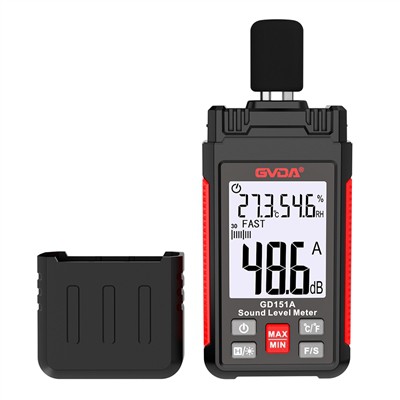
(2) "Fast". With a time constant of 125 ms, it is generally used to measure unsteady noise with large fluctuations and transport noise. The fast gear is close to the human ear's response to sound.
(3) "Pulse or Pulse Hold". The rise time of the meter needle is 35ms , which is used to measure impulse noise with long duration, such as punch, press hammer, etc. The measured value is the *large RMS value.
(4) "Peak hold". Meter needle rise time less than 20ms . Used to measure impulse noises with short duration, such as gun, cannon and explosion noises, the measured value is the peak value . That is, the * large value.