What are the similarities and differences in the principles of current measurement between a multimeter and a clamp meter?
Both multimeters and clamp meters have their unique advantages and principles in measuring current. Below, we will provide a detailed introduction to the similarities and differences between these two testing tools.
A multimeter, also known as a multimeter, is one of the most commonly used electronic testing tools. It can measure electrical parameters such as voltage, current, resistance, and frequency, as well as test the performance of electronic components such as battery level, diodes, transistors, and relays. Strictly speaking, a multimeter is not a specialized tool for measuring current, but it can achieve current measurement through range switching and different test line clamps.
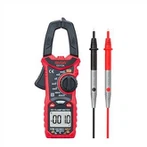
Unlike a multimeter, a clamp meter is a specialized current testing tool. Its working principle is to use induction to measure the current in the circuit. The clamp meter consists of a magnetic ring clamped on the circuit and a circuit board connected to a digital display screen. When current flows through a circuit, a corresponding magnetic field is generated. The magnetic ring correspondingly senses this magnetic field, outputs a voltage signal, and finally the digital display screen displays this current value.
The main differences between a multimeter and a clamp meter in measuring current are as follows.
1. A clamp meter can achieve non-contact measurement of current. A multimeter requires the test wire to be clamped onto the wire in the tested circuit, while a clamp meter does not need to directly contact the wire, which greatly improves the safety and convenience of use.
2. The accuracy of the clamp gauge is higher. Due to its measurement principle being more sensitive than a multimeter, a clamp meter can detect very weak currents in a circuit. In addition, its measurement error is much smaller than that of a multimeter, reaching several percent. This is very important for high-precision current measurement of motors, transformers, and other devices.
3. Clamp on meters are only applicable to AC circuits. Due to the working principle of the clamp meter being based on electromagnetic induction, it can only measure current in AC circuits. A multimeter can measure the current in both DC and AC circuits.
4. The price of a clamp shaped watch is relatively higher. Due to its technical principles and high production costs, the price of clamp gauges is much higher than other tools.
Overall, clamp gauges have unique advantages in measuring current, especially for high-precision measurements in AC circuits. A multimeter, on the other hand, is more versatile and can measure various parameters in a circuit, including voltage, current, resistance, capacitance, and so on. Of course, the choice between the two also depends on the specific testing needs and budget constraints of the users.