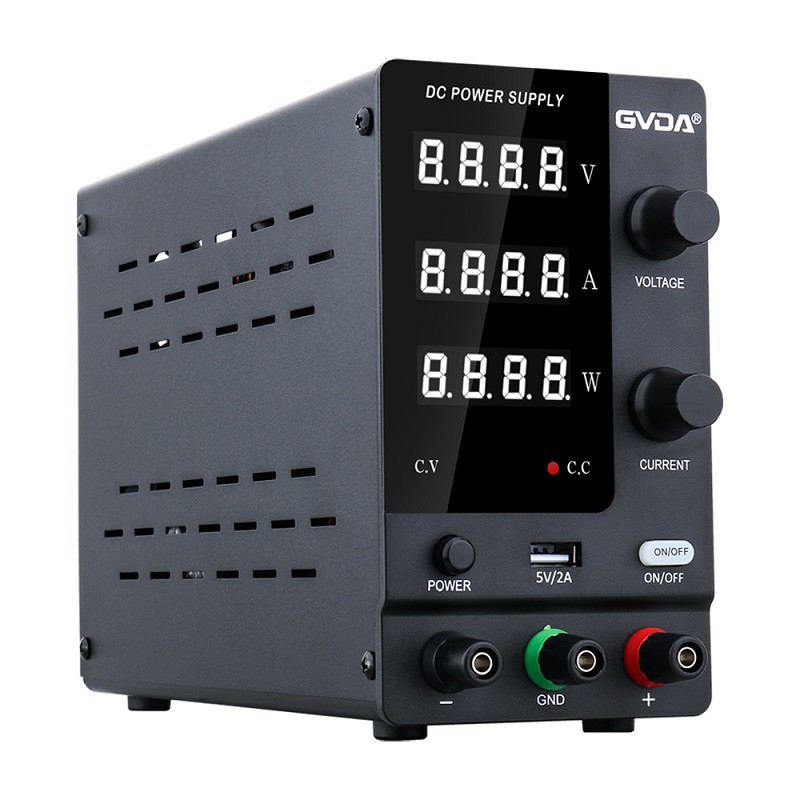
Working Principle and Brief Introduction of DC Regulated Power Supply
The typical circuit block diagram of a transistor series DC stabilized power supply is shown in the figure. It consists of a rectification and filtering circuit, a series regulator circuit, an auxiliary power supply, and a protection circuit.
The rectification and filtering circuit includes a power transformer, rectification circuit, and filtering circuit. The commonly used DC power supplies for semiconductor circuits have rated voltage values such as 6V, 12V, 18V, 24V, and 30V, while the grid voltage is generally AC 220V. To convert the AC voltage of the grid into the required DC voltage, it must first be stepped down by a power transformer, and then the AC power is converted into pulsating DC power through a rectification circuit. Due to the large AC component in the rectified voltage, it must be filtered out by a filtering circuit to obtain a relatively smooth DC voltage.
The DC voltage obtained after passing through the filtering circuit has reduced pulsation, but the voltage value is still unstable. There are three main reasons for this: firstly, the voltage of the AC power grid generally fluctuates by about ± 10%, which can cause fluctuations of about ± 10% in the DC voltage output by rectification and filtering; Secondly, there is an internal resistance in the rectification and filtering circuit. When the load current changes, the voltage drop across the internal resistance will also change, causing the output DC voltage to also change accordingly; Thirdly, in the rectification and voltage stabilization circuit, the characteristics of the semiconductor devices used vary with the ambient temperature, which also causes unstable output voltage.
A voltage regulator circuit can maintain the stability of the output DC voltage, preventing it from changing with changes in grid voltage, load, or temperature. The series type voltage regulator circuit consists of an adjustment element, a comparison amplifier circuit, a sampling circuit, a reference voltage, and other components. The adjustment tube in the adjustment process is connected in series between the filter circuit and the load, hence it is called a series regulator circuit. Adjusting the tube is equivalent to a variable resistor. If the output voltage increases, its resistance value increases accordingly, causing the output voltage to drop back; On the contrary, if the output voltage decreases, its resistance value decreases accordingly, causing the output voltage to increase. By adjusting the output voltage in this way to maintain it constant, the goal of voltage stabilization can be achieved.
The sampling circuit uses the method of resistor voltage division to sample the change in output voltage in a certain proportion, which is the sampling signal. The reference voltage is a stable and standard reference voltage. The sampled signal and the reference voltage are simultaneously applied to the comparison amplification circuit for comparison, and then the difference between the two is amplified. The amplified voltage is used to control the injection current of the base of the adjustment tube, thereby changing the DC internal resistance of the adjustment tube and stabilizing the output voltage. To improve the performance of voltage regulators, two-stage differential amplifiers are often used in comparative amplification circuits, with larger amplification factors and stronger control capabilities. Secondly, comparative amplification circuits also require small zero drift and good temperature stability.