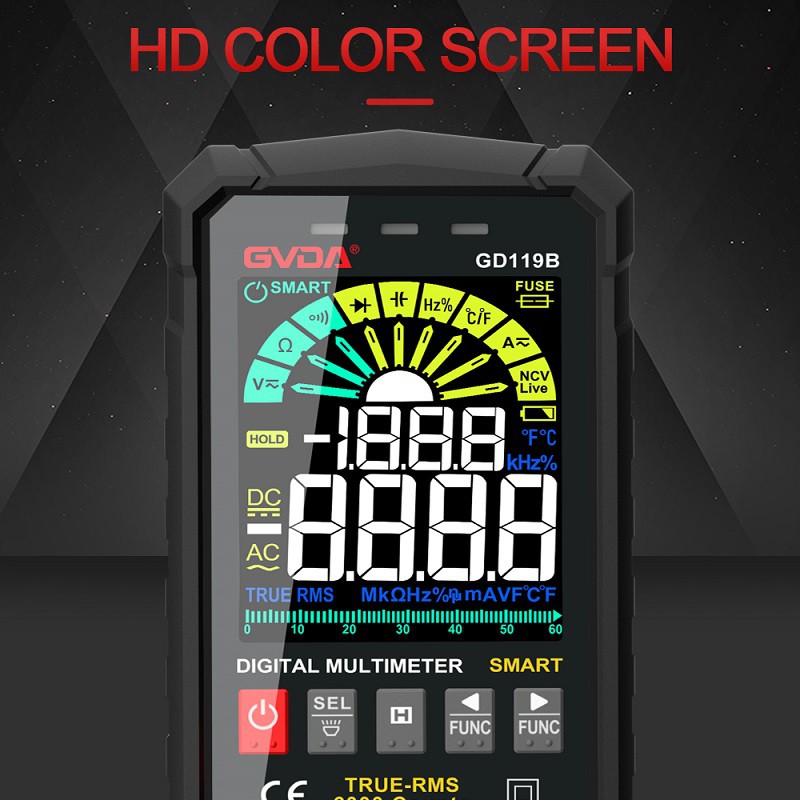
Common Equipment and Selection Principles of Multimeters
The digital multimeter is currently the most commonly used digital instrument. Its main characteristics are high accuracy, strong resolution, complete testing functions, fast measurement speed, intuitive display, strong filtering ability, low power consumption, and easy to carry. Since the 1990s, digital multimeter has been rapidly popularized and widely used in China, becoming an essential instrument for modern electronic measurement and maintenance work, and gradually replacing traditional analog (i.e. pointer) multimeter.
Digital multimeter, also known as digital Multimeter (DMM), has a wide variety of models. Every electronic worker hopes to have an ideal digital multimeter. There are many principles for choosing a digital multimeter, and sometimes they may vary from person to person. But for handheld (pocket) digital multimeter, it should generally have the following characteristics: clear display, high accuracy, strong resolution, wide testing range, complete testing functions, strong anti-interference ability, relatively complete protection circuit, beautiful appearance, generous appearance, easy operation, flexibility, good reliability, low power consumption, easy portability, affordable price, and so on.
The main indicators, display digits, and display characteristics of a digital multimeter
The display digits of a digital multimeter are usually 3 1/2 to 8 1/2 digits. There are two principles for determining the display digits of a digital instrument: firstly, the digits that can display all digits from 0 to 9 are integer digits; The second is that the numerical value of the fractional digit is based on the highest digit in the maximum displayed value as the numerator, and when measuring at full scale, the value is 2000. This indicates that the instrument has 3 integer digits, while the numerator of the decimal digit is 1 and the denominator is 2, so it is called 3 1/2 digits, pronounced as "three and a half digits". Its highest digit can only display 0 or 1 (0 is usually not displayed). The highest digit of a 32/3 digit (pronounced as "three and two-thirds digits") digital multimeter can only display numbers ranging from 0 to 2, so the maximum display value is ± 2999. In the same situation, it is 50% higher than the limit of a 3 1/2 digit digital multimeter, especially valuable for measuring 380V AC voltage.
Popular digital multimeter generally belongs to handheld multimeter with 3 1/2 digit display, while 4 1/2 and 5 1/2 digit (below 6 digits) digital multimeter can be divided into handheld and desktop types. Most of the 6 1/2 digits or above belong to desktop digital multimeters.
The digital multimeter adopts advanced digital display technology, with clear and intuitive display and accurate reading. It not only ensures the objectivity of readings, but also conforms to people's reading habits, and can shorten the reading or recording time. These advantages are not possessed by traditional analog (i.e. pointer) multimeters.
Accuracy
The accuracy of a digital multimeter is the combination of systematic and random errors in measurement results. It represents the degree of consistency between the measured value and the true value, and also reflects the magnitude of measurement error. Generally speaking, the higher the accuracy, the smaller the measurement error, and vice versa
The accuracy of a digital multimeter is much better than that of an analog pointer multimeter. The accuracy of a multimeter is a very important indicator, which reflects the quality and process capability of the multimeter. A multimeter with poor accuracy is difficult to express the true value, which can easily lead to misjudgment in measurement.
Resolution
The voltage value corresponding to the last word on the lowest voltage range of a digital multimeter is called resolution, which reflects the sensitivity of the instrument. The resolution of digital instruments increases with the number of displayed digits. The highest resolution indicators that a digital multimeter with different digits can achieve are different.
The resolution index of a digital multimeter can also be displayed using resolution. Resolution refers to the percentage of the minimum number (excluding zero) that the instrument can display to the maximum number.
It should be pointed out that resolution and accuracy belong to two different concepts. The former characterizes the "sensitivity" of the instrument, that is, the ability to "recognize" small voltages; The latter reflects the "accuracy" of the measurement, that is, the degree of consistency between the measurement results and the true value. The two are not necessarily related, so they cannot be confused, let alone mistakenly assume that resolution (or resolution) is similar to accuracy, which depends on the comprehensive error and quantization error of the internal A/D converter and functional converter of the instrument. From a measurement perspective, resolution is the "virtual" indicator (independent of measurement error), while accuracy is the "real" indicator (which determines the size of measurement error). Therefore, increasing the number of display digits arbitrarily to improve the resolution of the instrument is not feasible.
measuring range
In a multifunctional digital multimeter, different functions have corresponding maximum and minimum values that can be measured.
Measurement rate
The number of times a digital multimeter measures the amount of electricity being measured per second is called the measurement rate, and its unit is "times/s. It mainly depends on the conversion rate of the A/D converter. Some handheld digital multimeters use measurement cycles to indicate the speed of measurement. The time required to complete a measurement process is called the measurement cycle.
There is a contradiction between measurement rate and accuracy indicators, usually the higher the accuracy, the lower the measurement rate, and it is difficult to balance the two. To solve this contradiction, different display digits or measurement speed conversion switches can be set on the same multimeter: add a fast measurement gear, which is used for A/D converters with faster measurement speed; By reducing the number of display digits to significantly increase the measurement rate, this method is relatively common in application and can meet the needs of different users for measurement rate.
Input impedance
When measuring voltage, the instrument should have a high input impedance, so that the current drawn from the measured circuit during the measurement process is minimal and does not affect the working state of the measured circuit or signal source, which can reduce measurement errors.
When measuring current, the instrument should have a very low input impedance, which can minimize the impact of the instrument on the measured circuit as much as possible after being connected to the measured circuit. However, when using the current range of a multimeter, due to the small input impedance, it is easier to burn the instrument. Please be careful when using it.