Food Thermometer Grilling Guide
Grilling is both an art and a science, and there are many factors you must consider when deciding to cook something mouth-watering. It is the best choice to take into account both taste and safe consumption.
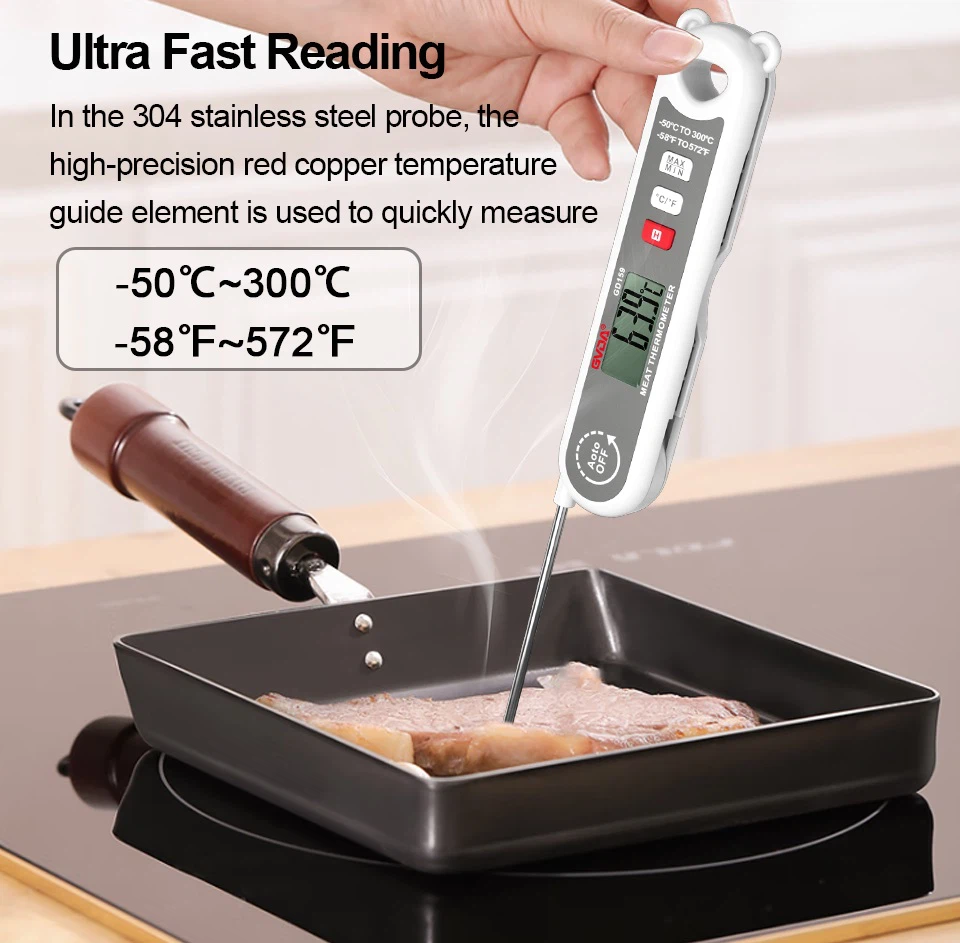
While many people will tell you that the best way to do this is to simply look at the color of the meat and its juices (which can be a good way to tell if you know what to look for), a simpler method that doesn't require opening the lid to keep an eye on food color The best way is to measure the internal temperature with a thermometer. There are many types to choose from and it is highly recommended that you purchase one to ensure your meat is 100% safe to eat.
When you use the thermometer, be aware that the internal temperature of the meat on the grill is different than when it was cooling. Usually it's about 5 degrees higher, which is completely normal. The cooling time can be anywhere from 3 minutes to 30 minutes, depending on how big your dishes are and various other factors.
Here's a list of the different types and cuts of meat, with recommendations for the lowest temperature: beef, lamb, or veal
On the grill, most beef, veal and lamb are served as steaks, chops or roasts. However, for smoky slow-roasting and other purposes, ground meat is also included.
Ribs, Roast and Steaks
Beef, lamb, and veal steaks, roasts, or steaks are not completely safe to eat until their internal temperature reaches at least 145°F after three minutes.
Medium Rare - The internal temperature should be 120°F and the resting temperature should be around 125°F
Medium Rare - The internal temperature should be 125°F and the resting temperature should be around 130°
Medium Rare - The internal temperature should be 130°F and the resting temperature should be around 140°F
Medium Rare - The internal temperature should be 145°F and the resting temperature should be around 150°F
Well done - the internal temperature should be 155°F and the resting temperature should be around 160°F
minced meat
Ground beef, lamb, and veal have an internal temperature of at least 160°F to be completely safe to eat.
Medium rare - not recommended
Medium rare - not recommended
Medium Rare - The internal temperature should be 140°F and the resting temperature should be around 145°F
Medium Rare - The internal temperature should be 150°F and the resting temperature should be around 155°F
Well done - the internal temperature should be 160°F and the resting temperature should be around 165°F
pork
Pork is one of the most commonly grilled foods and comes in a variety of different cuts and types, including steak, shoulder, roast, ribs, and ham. Of course, ribs are also common, but ribs are rarely set to "done" as determined by internal temperature, so to keep things simpler, I didn't include them in this list.
Ribs, Roast and Steaks
Pork steaks, ribs, or roasts are not completely safe to eat until their internal temperature reaches at least 145°F after three minutes.
Medium Rare - The internal temperature should be 125°F and the resting temperature should be around 130°F
Medium Rare - The internal temperature should be 130°F and the resting temperature should be around 135°
Medium Rare - The internal temperature should be 140°F and the resting temperature should be around 145°F
Medium Rare - The internal temperature should be 150°F and the resting temperature should be around 155°F
Well done - the internal temperature should be 155°F and the resting temperature should be around 160°F
pork shoulder
When slow-smoking pork shoulder, the meat should reach a minimum temperature of 200°F. Kamado should be smoked between 225-275°F. The time needed depends on the pork shoulder
the size and desired taste.
Ham
There are some subtle differences between smoked and grilled fresh and precooked hams.
Fresh Ham - The internal temperature should reach 140°F and the resting temperature should reach 145°F. It is safe to eat if it reaches at least 145°F after three minutes.
Precook Ham - The internal temperature should reach 135°F and the resting temperature should reach 140°F. It is safe to eat if it is at least 140°F after holding.
minced meat
Ground pork has an internal temperature of at least 160°F to be completely safe to eat.
Medium rare - not recommended
Medium rare - not recommended
Medium Rare - The internal temperature should be 140°F and the resting temperature should be around 145°F
Medium Rare - The internal temperature should be 150°F and the resting temperature should be around 155°F
Well done - the internal temperature should be 160°F and the resting temperature should be around 165°F
poultry
Poultry, including chicken, duck, goose and turkey, must be cooked with care to avoid any risk of disease. However, the process and temperature are the same whether cooking whole or cut. The meat should always be white, as undercooked poultry can be fatal.
Meat is considered done when it reaches 160°F on the grill. When cooled, the temperature should be at least 165°F.
seafood
There are many different kinds of seafood (and many different sizes) that can be grilled, so there's no way to list a definitive temperature guideline. However, there are some general guidelines as to whether or not it has been done.
Finfish - Recommended minimum temperature is 145°F. The fish should be opaque, firm and come apart easily with a fork.
Scallops - The flesh should be opaque milky white and firm.
Clams and Oysters - Cook until shells open.
Crab, Lobster, and Shrimp - Cook until the flesh is opaque and pearly white.
vegetable
We discussed grilling vegetables earlier, and in general, you can actually grill most vegetables without worrying about the temperature of the foil alone. However, if you do want to put them directly on the grill and need help determining the temperature, there are a few guidelines to keep in mind.
Artichokes - 350°F -- cut in half and flatten leaves, then brush with olive oil and salt
Asparagus - 400-425°F -- tossed in olive oil, then salted
Corn - 350°F -- soak and shuck before grilling
Eggplant - 400-425°F - cut into circles and brushed with olive oil
Leeks - 350°F -- halved lengthwise and brushed with olive oil
Mushrooms - 400-425°F -- roasted whole and sliced as desired
Onions - 400-425°F - cut into rings and brushed with olive oil, then salted and grilled
Peppers - 400-425°F -- brush with olive oil and cook for a few minutes on each side
Zucchini - 400-425°F -- sliced, brushed with olive oil, and sprinkled with salt