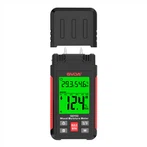
How does a multimeter measure current?
When measuring DC current, set one switch of the multimeter to the DC current block, and the other switch to the appropriate range from 50uA to 500mA. The range selection and reading method of the current is the same as that of the voltage. When measuring, the circuit must be disconnected first, and then the multimeter is connected in series to the circuit under test according to the direction of the current from "+" to "-", that is, the current flows in from the red test lead and flows out from the black test lead. If the multimeter is connected in parallel with the load by mistake, the internal resistance of the meter head is very small, which will cause a short circuit and burn the meter. The reading method is as follows: actual value = indicated value × range / full deviation
Matters needing attention in the method of measuring current with multimeter
1. When measuring current and voltage, it is not possible to change the range with electricity
2. When selecting the range, choose the large one first, then the small one, and try to make the measured value close to the range
3. When measuring resistance, do not measure with power on. Because the multimeter is powered by the internal battery when measuring resistance, if the measurement is live, it is equivalent to connecting an additional power supply, which may damage the meter head.
4. After use, the transfer switch should be in the maximum gear of AC voltage or in neutral gear.
5. Note that when changing the range of the ohmmeter, it is necessary to perform ohm zero adjustment instead of mechanical zero adjustment.
There are two ways to measure current with a digital multimeter. The first method is to directly use the digital multimeter for current measurement, which requires connecting the multimeter in series with the circuit under test, which means disconnecting the circuit and using the test leads of the digital multimeter to form a complete circuit. In this way, the entire circuit current flows through the circuit of the digital multimeter.
Another indirect method of measuring current with a DMM is to use a multimeter accessory known as a current probe. Clamps the probe around the conductor, eliminating the need to break the circuit and allowing measurement of high currents greater than 10A.
How to use a digital multimeter to measure current
To avoid damage to the multimeter or the equipment under test:
Check the multimeter's fuses before measuring current. ·
When measuring, you must use the correct terminal, function file and range file. ·
Never connect the probes across (in parallel with) any circuit while the test leads are plugged into the current terminals. To directly measure current with a multimeter, you must disconnect the circuit under test, then connect the multimeter in series with the circuit, as follows:
1) With circuit power removed, all high voltage capacitors are discharged, creating a location where the multimeter probes can be inserted
2) Select A~ (AC) or A (DC) according to the needs and refer to the user manual of the product. Plug the black test probe into the COM input jack. Insert the red test probe into the ampere (A) or milliamp (mA/uA) input jack, depending on the expected reading.
3) If you use the A terminal, please set the rotary switch to the mA/A position. If you are using the mA/µA terminals, set the rotary switch to the µA position (for currents below 6000 µA (6 mA)) or the mA/A position (for currents above 6000 µA). Connect the probe tips across the disconnect so that the full current flows through the DMM (in series). (Touch the higher end of the disconnected circuit with the red probe and the lower end with the black probe. Reversing the polarity of the probes will produce a negative reading, but will not damage the multimeter)
4) Reconnect the power supply of the circuit and read the displayed value; be sure to pay attention to the measurement unit. 4)
Reconnect power to the circuit and read the display; be sure to note the unit of measure.
5) Turn off circuit power and discharge all high voltage capacitors. Remove the multimeter wiring and restore the circuit to normal operation.
input protection
A common mistake when measuring current with a DMM is to attempt a voltage measurement while the test leads are still plugged into the current input jacks. This creates a direct short across the power supply due to a low value resistor (called a shunt) inside the DMM. A large current will flow through the DMM, and if the protection is not adequate, it will cause great damage to both the DMM and the circuit, and possibly injure the operator. If industrial high voltage circuits (240 V or higher) are involved, extremely high fault currents can occur.
Therefore, the DMM should have current input fuse protection, and its protection capacity should be high enough for the circuit under test. A multimeter without fuse protection at the current input cannot be used for measuring high energy circuits (> 240 V ac). For DMMs that use fuses, the breaking capacity of the fuses should be sufficient to clear high energy faults. The voltage rating of the multimeter fuse should be greater than the highest voltage expected to be measured. For example, a 20 A/250 V fuse may not clear a fault in the multimeter when it is connected across a 480 V circuit. To clear faults on 480V circuits, use a 20 A/600 V fuse. Fluke digital multimeters use high-energy and fast-response fuses to protect the safety of users and instruments.
Current Probe Accessories
At times, you may have to measure currents that exceed the DMM's ratings, or circumstances may not allow you to break a circuit to measure current. Current probes are useful in these high current applications (typically greater than 2 A) where high accuracy is not required. A current probe can be clipped onto an energized conductor and it will convert the measurement to a magnitude that the multimeter can handle. There are two basic types of current probes: current transformers, which measure AC current only, and Hall-effect probes, which measure AC or DC current. The output of a current transformer is typically 1 mA per ampere. The 100 A current value will be reduced to 100 mA, which can be safely measured by most DMMs. The probe leads are connected to the "mA" and "COM" input jacks, and the function switch of the multimeter is set to the "mA ac" position. The output of the Hall effect probe is 1 mV per ampere (ac or dc). For example, 100 A (ac) will be converted to 100 mV (ac). The probe leads are connected to the "V" and "COM" jacks. Set the function switch of the multimeter to the "V" or "mV" position, select V~ for AC current measurement, and select V for DC current measurement. The multimeter displays 1 mV for each ampere measured.