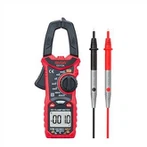
How to measure the good and bad of the SCR
There are two types of SCRs: unidirectional SCRs and bidirectional SCRs, both with three electrodes. Unidirectional SCRs have a cathode (K), anode (A), and control pole (G). Bidirectional thyristor is equivalent to two single thyristor reverse parallel. That is, one of the unidirectional silicon anode and the other cathode side by side, its lead end is called T2 pole, one of the unidirectional silicon cathode and the other anode is connected to the lead end is called T2 pole, and the rest is the control pole (G).
1, single, bidirectional thyristor discernment: first any two poles, if the positive and negative measurement of the pointer are not moving (R × 1 block), may be A, K or G, A pole (on the unidirectional thyristor) may also be T2, T1 or T2, G pole (on the bidirectional thyristor). If one of the measurement instructions for tens to hundreds of ohms, it must be unidirectional thyristor. And the red pen connected to the K pole, the black pen connected to the G pole, the rest is the A pole. If the positive and negative measurement instructions are tens of hundreds of ohms, it must be a bidirectional SCR. Then dial the knob to R × 1 or R × 10 block retest, which must be a slightly larger resistance, a slightly larger red pen connected to the G pole, black pen connected to the T1 pole, the rest is T2 pole.
2, the difference in performance: the knob will be dialed to R × 1 block, for 1 ~ 6A unidirectional SCR, the red pen to K pole, black pen at the same time connected to the G, A pole, in keeping the black pen does not detach from the state of the A pole under the G-pole, the pointer should indicate a few tens of ohms to one hundred ohms, at this time the SCR has been triggered, and the trigger voltage is low (or triggering current is small). Then instantaneously disconnect the A-pole and then connected, the pointer should be returned to the ∞ position, which indicates that the SCR is good.
For 1 ~ 6A bidirectional thyristor, the red pen connected to the T1 pole, the black pen at the same time connected to the G, T2 pole, in order to ensure that the black pen does not detach from the T2 pole under the premise of disconnecting the G pole, the pointer should be indicated as tens of more than one hundred ohms (depending on the size of the current of the thyristor, different manufacturers and different). Then the two pens will be adjusted, repeat the above steps to measure a pointer than the last slightly larger than a dozen to dozens of ohms, indicating that the SCR is good, and the trigger voltage (or current) is small. If you keep connected to the A pole or T2 pole when disconnecting the G pole, the pointer immediately returned to the ∞ position, then the SCR trigger current is too large or damaged. Can be further measured in accordance with Figure 2, for unidirectional SCR, close the switch K, the light should be bright, disconnect the K light is still not extinguished, otherwise the SCR is damaged.
For bi-directional SCR, close the switch K, the light should be bright, disconnect K, the light should not be extinguished. Then the battery is reversed, repeat the above steps, should be the same result, it is good. Otherwise, the device is damaged.
For bi-directional silicon controlled, close the switch K, the light should glow, disconnect K, the light should not be extinguished. Then the battery is reversed, repeat the above steps, should be the same result, to indicate that it is good. Otherwise, the device is damaged.
Bidirectional thyristor also has three poles, Ij control rice G and the first anode T1, the second anode T2. in fact, T1 and T2 are interchangeable.
1, polarity discrimination
T1 pole and G pole discrimination: with a multimeter Rx10 block, respectively, to measure the positive and negative resistance between the poles, if you find that the two poles between the positive and negative anode resistance are very small (about 150ll or so), the two poles are T1 and G pole. Then the multimeter set 'f-Rx1 block, rotate the measurement of the two poles, reverse resistance, the measured resistance value of a smaller black pen connected to the T1 pole, the other for the control pole C, the remaining foot T2 pole. To} bi-directional SCR is MAC97A6 / M329 model, measured with MF47F multimeter. If the resistance value measured with Rx100 block is different (in the 500ll or so), should be noted. If the measurement of high-power SCR data will be different, small current can not be triggered, the multimeter also need to add (series) voltage can be carried out.
2, to identify good and bad and conductivity
Can be placed in the multimeter Rxlk block, measuring T1 and T2, G and T1 resistance between, if the resistance is very small, indicating that the SCR has broken down. If the measured G and T2 pole positive and negative resistance are very large (normal should be in the hundreds of ohms or so). That is, it has been broken.
Discriminate the SCR's ability to conduct, the black pen of the multimeter can be connected to the T1 pole, the red pen connected to the T2 pole. With a dry cell as a trigger power (also available another multimeter Rx1 instead), then the needle is conduction, the dry cell is still conduction, this is to identify the T1 to T2 conduction pieces can be. The principle is very simple, the positive pole of the battery connected to T1, the negative pole of the G false dry cell to form a trigger voltage, the current path: from dry cell 10-T1 a G thousand batteries, the formation of the current path was triggered, then the multimeter is also used as a power supply, the negative pen within the + - T1 - T2 a positive pen Inside a, the formation of T1 to T2 path.