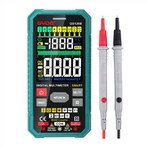
How to use a multimeter to find problems
1. How the multimeter records intermittent faults:
Use the minimum/maximum/average recording mode of the multimeter, select the corresponding function (AC voltage, DC voltage, resistance, AC current, DC current, and frequency) according to the measurement item, and ensure that it is connected before activating the min/max/average function Test the circuit, otherwise the minimum reading will always be the ambient value before the test leads are connected. This affects the analysis of the recorded data after the recording time has elapsed. jActivate the Min/Search Max/Average recording mode, the maximum reading will be indicated on the multimeter display and a beep will sound when a new maximum or minimum value is detected. whine.
The advantage of this is that when ensuring that the digital multimeter will not be tampered with and will not pose a safety hazard to any human beings, you can leave the digital multimeter in place for measurement and focus on other work. At any time during the logging cycle, you can view saved readings, or pause logging mode without deleting saved readings.
2. How does the multimeter continuously record intermittent faults:
Some multimeters not only have the minimum/maximum/average recording function, but also combine this function with another function called AutoHOLD and a larger memory to form Event Logging. Gong Qiong. The auto-hold feature senses when the measurement signal becomes unstable and when it becomes stable again. Utilizing the auto-hold function to trigger the start and stop of the min/max recording function allows the DMM to go beyond just detecting faults that produce min or max values.
If the multimeter has an infrared RS232 interface, the continuous recording function will be more powerful, and it can be a simple event collector to transmit the data collected by its multimeter to the computer. Using a computer, a detailed analysis of each stable and unstable event can be performed. Not only can you see the minimum and maximum values during each stable and unstable period, but you can also see when each period begins and ends. In addition, average values are recorded for each cycle. At the same time, it can dynamically detect the change trend graph of voltage or current.
3. How the multimeter marks the recording time:
The time at which the minimum and maximum values were detected is very useful information for determining the cause of intermittent failures. A digital multimeter in Min/Max/Average recording mode can store the amount of time between when a recording is started and when a new minimum, maximum, or average value is saved. Therefore, each saved minimum, maximum and average value has a "time stamp" corresponding to it.
Now, digital multimeters with digital acquisition or storage functions also have the same strip recording function through computers or their own memory. If the DMM has a Min/Max/Average recording mode, like a tape recorder, the DMM also takes readings at regular intervals. But instead of saving a reading with a tape recorder, the reading is compared to the previously saved reading to determine if the value is higher than the previous maximum value or lower than the previous minimum value j If so, the new reading will be replaced The value originally held in the high or low reading register. After recording for a period of time, you can recall the values of these registers for display, and view the maximum and minimum values during the recording time.