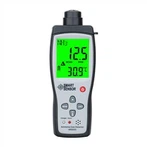
Instructions for the use of clamp watches in building construction
The clamp meter is used to measure the load condition of a circuit, but through flexible use, it can allow the clamp meter to determine which sockets the circuit breaker controls and measure each load (load and ground current) to quickly solve load problems.
Instructions for use
The clamp meter is used to measure the load condition of a circuit, but through flexible use, it can allow the clamp meter to determine which sockets the circuit breaker controls and measure each load (load and ground current) to quickly solve load problems.
The clamp meter measures current by determining the magnetic field around the current carrying conductor.
There are basically no other practical methods to measure the current in electrical wiring systems. It is impractical to disconnect these circuits for a series circuit measurement, and even if you accidentally disconnect some critical loads, your career may be affected. Measurement is usually conducted on the distribution board, including measuring the load and balance on the three-phase feeder. When there is a large amount of harmonic load, it is also necessary to measure the neutral line on the distribution board. The motor condition can also be diagnosed through current measurement.
In addition to these basic measurements specifically designed for clamp type meters, modern digital clamp type meters also have voltage and resistance measurement functions. This means that a clamp type meter can be used for most common daily measurements. If an electrician can only carry one testing tool during work, it would be more reasonable to choose to wear his clamp type watch.
Moreover, the clamp type table should be a true RMS clamp type table, such as Fluke 335, 336, or 337. Another option is an average response instrument, which has a lower price compared to an average response instrument that only measures electronic loads (computers, televisions, lighting devices, motor drivers, etc.) on the circuit, but does not accurately measure current. It may not be accurate. The larger the electronic load, the greater the inaccuracy. A true RMS clamp table always gives accurate results (assuming, of course, you keep it calibrated) # Therefore, unless you can confidently say that you will not encounter this type of load, you should use a true RMS clamp table. In this way, you need to consider the work to be done, not the testing tool itself
1、 Using clamp type meters in residential applications
For residential facility electricians, clamp type meters are essential tools for measuring. Although spot checks on current are often sufficient, sometimes such checks do not provide a complete picture as the load is turned on and off, or undergoes several cycles.
The voltage in the electrical system should be stable, but the current varies greatly. To check for peak or worst-case loads on a circuit, use a clamp type meter with a minimum/maximum function designed to measure high currents that exist for more than 100 ms or approximately 8 cycles. These currents can cause intermittent overload conditions that can cause annoying tripping of the circuit breaker.
At the distribution board, the load on each branch circuit is measured on the load side of the circuit breaker or fuse. The circuit breaker will disconnect the circuit in the event of an accidental short circuit, which is particularly important for any type of direct contact voltage measurement. Even if the clamp of the clamp type meter has insulation, it is necessary to be cautious because it has a protection level that direct contact voltage measurement does not have.
A common problem in electrical work in residential facilities is to correspond electrical sockets to circuit breakers. Clamp type meters are very useful in identifying which circuit a specific socket is located in. Firstly, obtain a reference reading of the existing current of the circuit on the distribution board. Then, place the clamp table in the maximum/maximum mode. Go to the relevant socket, insert a load (a hair dryer is ideal), and turn on its power for one or two minutes. Check if the maximum current reading of the clamp type meter has changed. A hair dryer usually sucks in a current of 10-13 A, so there should be a noticeable difference. If the readings are the same, the circuit breaker is incorrect.