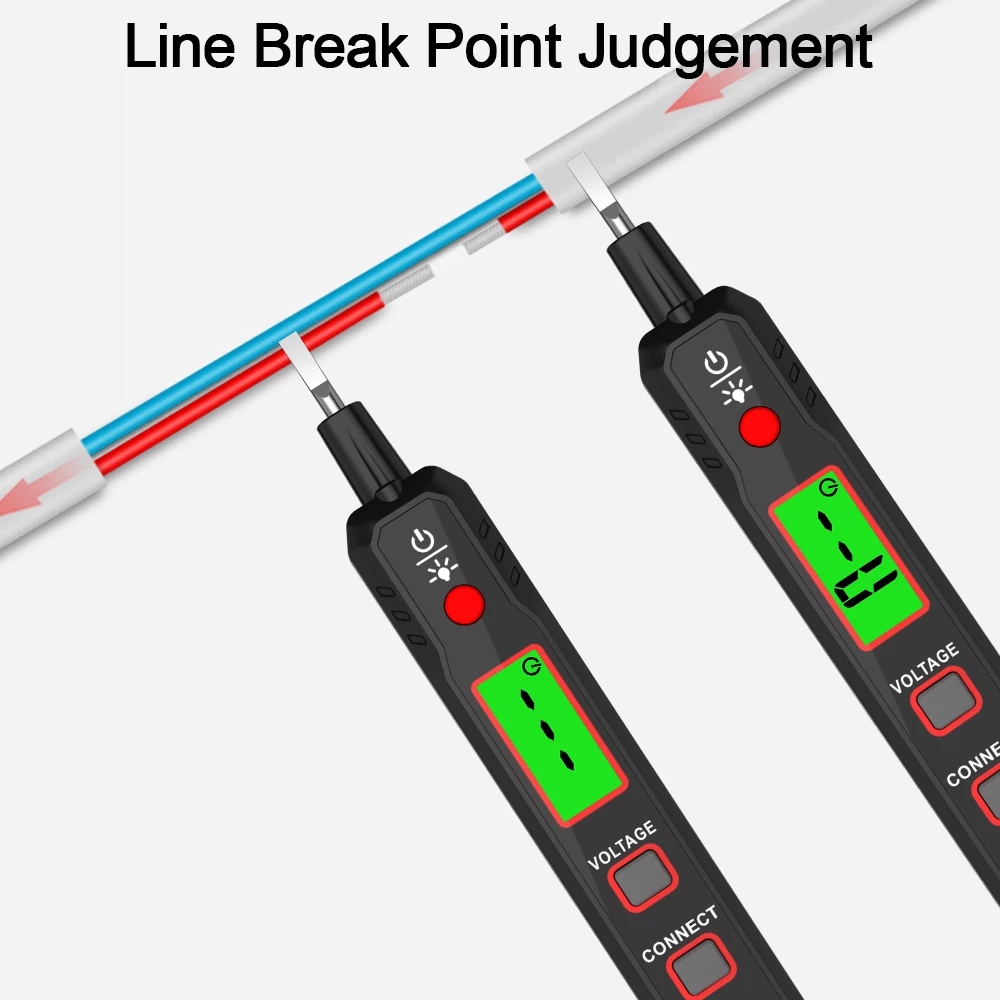
Introduction to the Operation Method of Digital Display Electric Pen
A test pen is one of the tools commonly used by electricians to determine whether an object is charged. Its internal structure is a light bulb with only two electrodes, filled with neon gas, commonly known as a neon bubble. One pole is connected to the pen tip, and the other pole is connected in series with a high resistance wire to the other end of the pen. When the voltage between the two poles of a neon bubble reaches a certain value, a glow is generated between the two poles, and the intensity of the glow is proportional to the voltage between the two poles. When the voltage between the charged body and the ground is greater than the glow voltage at the beginning of the neon bubble, and the tip of the measuring pen contacts it, the other end is grounded through the human body, so the measuring pen will emit light. The function of the resistance in the measuring pen is to limit the current flowing through the human body to avoid danger.
1. Immediate measurement method
The immediate measurement method refers to the measurement method where the camera of the measuring pen is directly in contact with the measured object to distinguish whether it is charged or not.
When applying the immediate measurement method, touch the metal material camera of the measuring pen with the measured object, and press the immediate precise measurement function key (DIRECT) with your hand;
If the measured object is electrified, the display light on the measuring pen will turn on. Additionally, the display will display information to measure the voltage level.
The general measuring pen can display information of 12V, 36V, 55V, 110V, and 220V. Under normal circumstances, the final displayed information value of the monitor is the measured voltage value.
Immediate measurement method (220V voltage)
In addition to being able to determine whether an object is electrified, the test pen also has the following purposes
(1) It can be used for low-voltage nuclear phase measurement to determine whether any wires in the circuit are in phase or out of phase. The specific method is to stand on an object that is insulated from the ground, hold a measuring pen with both hands, and then test on the two wires to be tested. If the two measuring pens emit very bright light, the two wires are out of phase; On the contrary, it is in phase, which is judged based on the principle that the voltage difference between the two electrodes of the neon bubble in the measuring pen is directly proportional to its luminous intensity.
(2) It can be used to distinguish between alternating current and direct current. When using a test pen for testing, if both poles in the neon bubble of the test pen emit light, it is an alternating current; If only one of the two poles emits light, it is direct current.
(3) It can determine the positive and negative terminals of direct current. Connect the test pen to a DC circuit for testing, and the electrode with the neon bubble shining is the negative electrode, while the electrode without the neon bubble shining is the positive electrode.
(4) It can be used to determine whether the DC is grounded. In a DC system with insulation to ground, standing on the ground can be used to contact the positive or negative poles of the DC system with a measuring pen. If the neon bubble of the measuring pen is not lit, there is no grounding phenomenon. If the neon bubble lights up, it indicates grounding, and if it lights up at the pen end, it indicates positive grounding. If it shines on the finger end, it is negative grounding. However, it must be pointed out that in DC systems with grounding monitoring relays, this method cannot be used to determine whether the DC system is grounded.