The short version of this review is that I think this is a nice little budget meter for primarily handyperson-type activities around the house. There are better products out there if you’re willing to spend more money, but I don’t think I could point you to another meter with better bang per buck.
There is a lot to think about when choosing a meter, and the longer version of this review would start by acknowledging that there are a staggering number of multimeter options out there because, once you’re beyond the basics, there really are a lot of different ways you can use a multimeter. The staggering number of options offered in the much-venerated Fluke lineup attests to how intensely specialized these instruments can get. There are specific models for electricians, HVAC technicians, automotive technicians, electronicists, and industrial controls work. There are multimeters meant to sit on a bench where the work comes to you, and multimeters meant to juggle in your hands as you go to and hover over the work. So you’ve got your work cut out for you in picking a good meter for your use case.
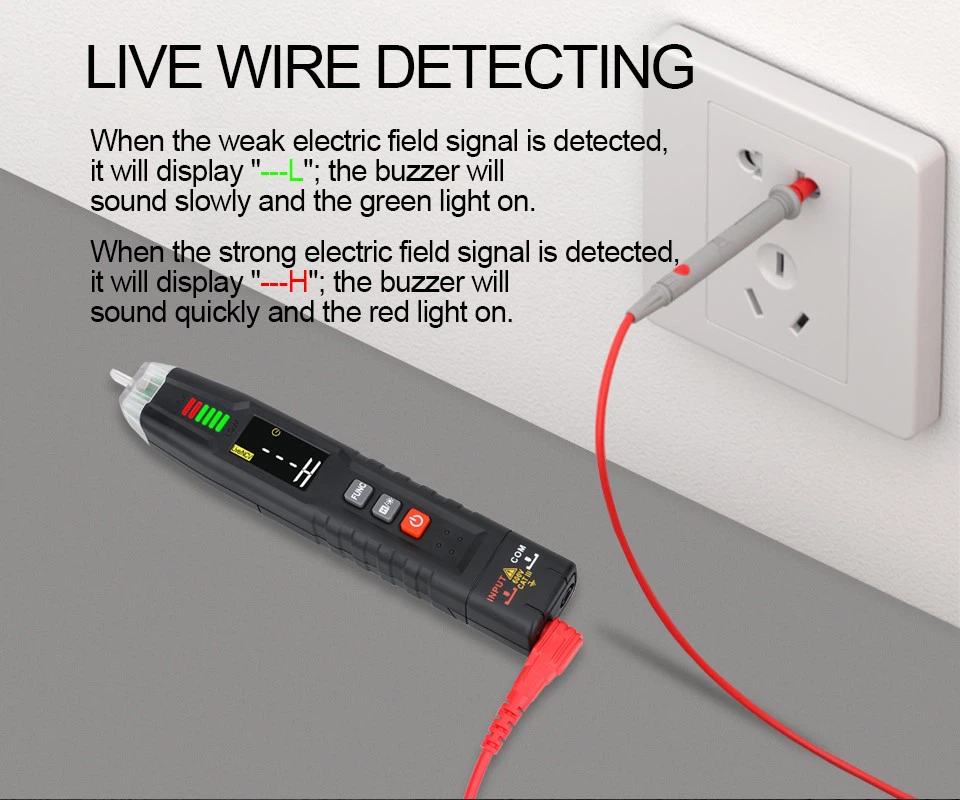
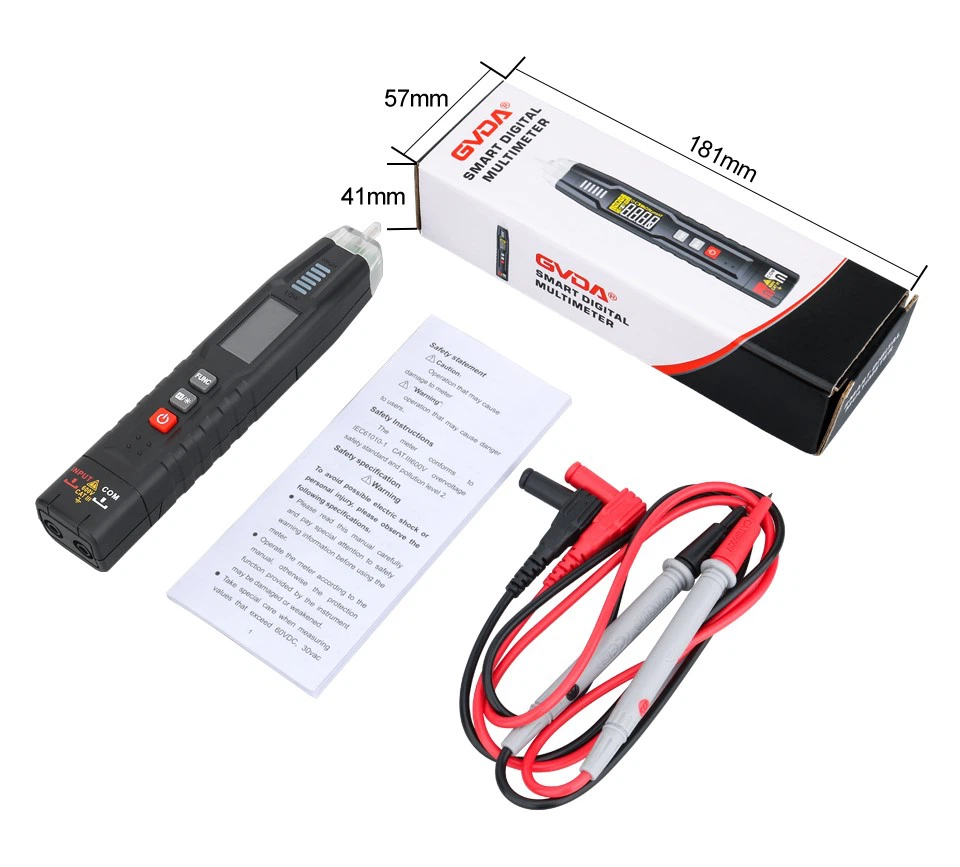
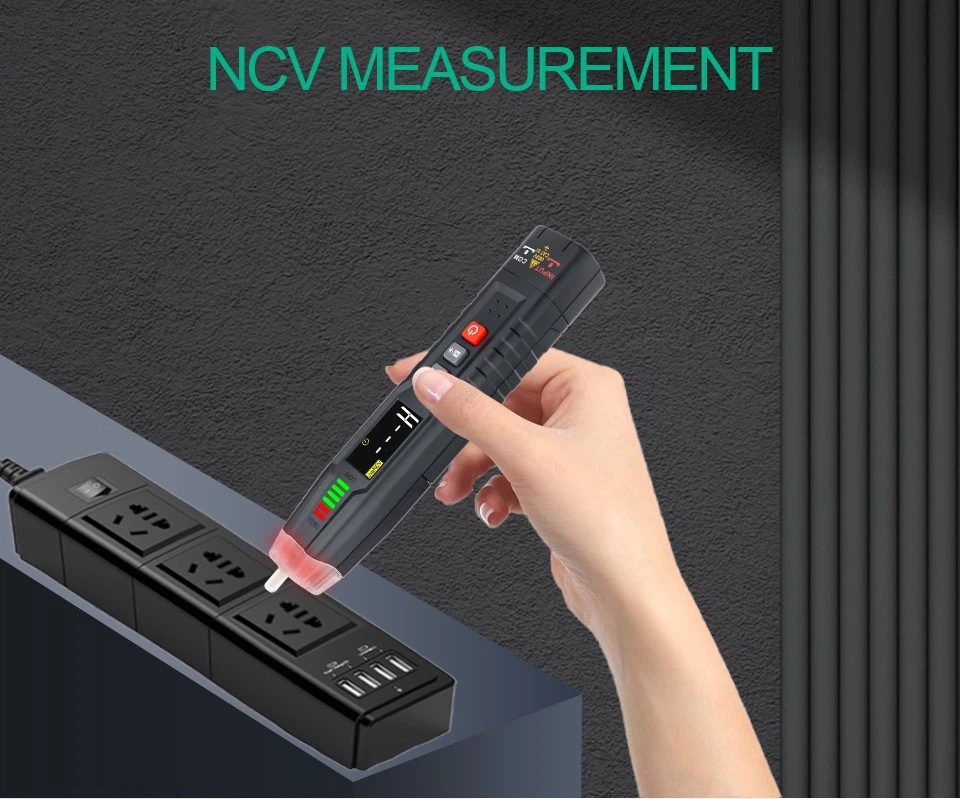
I view this product as a handyperson’s meter. The form factor, with one of the probes built into the body of the instrument, is suited for getting tasks done when you’re not sitting at a benchtop and only have two hands. You see something of the same thinking in the much more expensive Fluke T5 and T6 electrician’s testers (which do have two detachable probes but provide a holder spot for one of them to stick out the end of the instrument for a similar usage style). It’s convenient for moving around working on your home or car. I would have appreciated some kind of belt clip or holster, though. And having the red probe sticking out the top makes it a bit awkward to shove into a pocket without stabbing yourself. They do include tip covers, but those are tiny, fiddly things to keep track of while you’re trying to work on a house. It would have been nice if the covers somehow stowed on the unit itself or the red probe could actually retract inside the body of the unit to eliminate the need for a cover entirely, and nicer still if the black probe had a storage slot of some kind too. Also it might have been nice if the jack for the black probe had been placed on the side rather than the very bottom — with the right angle connector on the lead, it’s not as amenable to folding up the cable directly against the body of the meter. I do appreciate that the pen form factor eliminates half the wire you would normally have dangling from the unit, though.
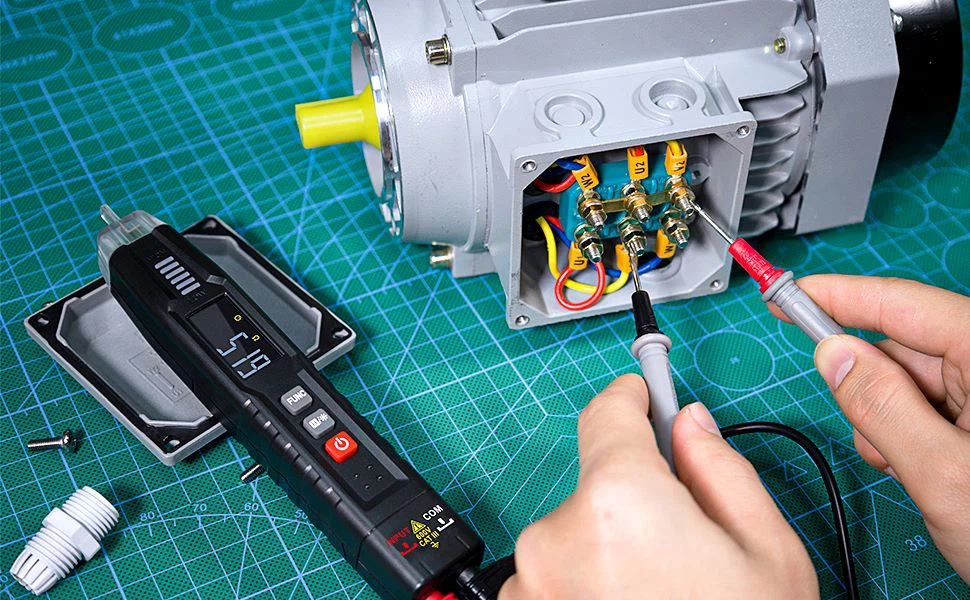
The display is oriented with the assumption that the main body (red probe) will be in your right hand. I don’t know if left handed people might find that annoying. Either way you’ve got one probe in each hand, though, so I’m not sure how much difference it really makes.
It makes a loud beep with every button press, which I suppose is a good thing insofar as it makes it very clear to the user every time something changes, but I find it annoying.Capacitance seemed a little low compared to my Fluke 117, but within specification. Voltage was accurate.
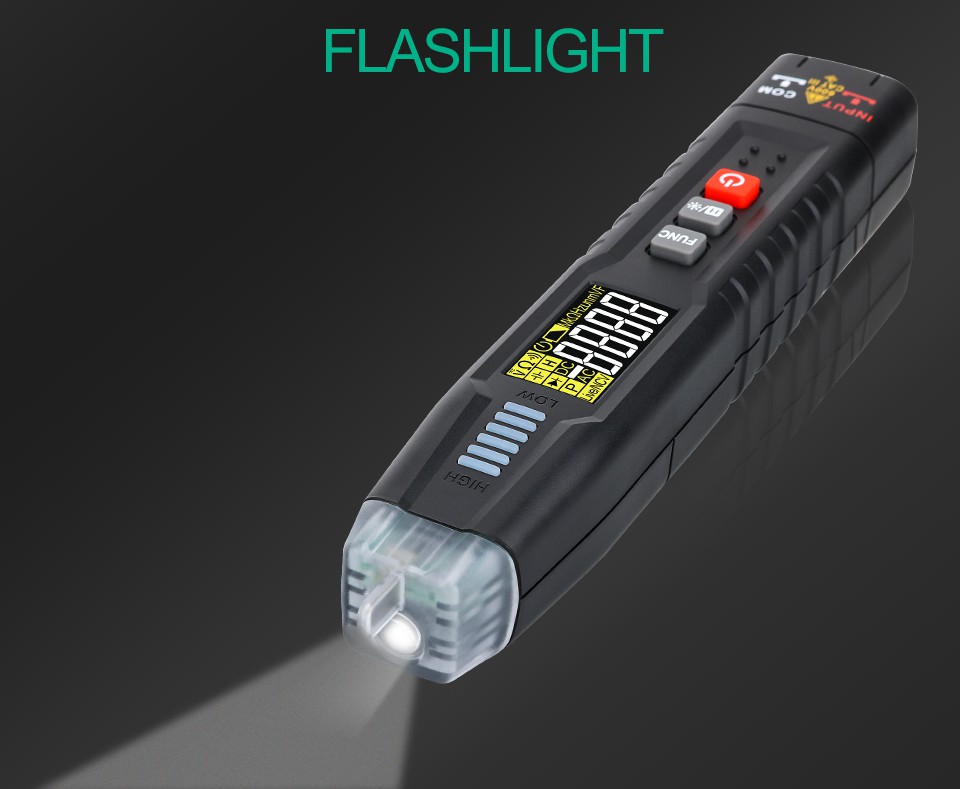
Having a small flashlight built in is a nice touch, particularly because the pen form factor means that the light is built in to one of your probes — so its always pointed at your work.
I was impressed that the screw for the battery compartment screws into a metal insert rather than tearing up the plastic each time you change the batteries. You don’t often find that nicety on a meter this cheap.
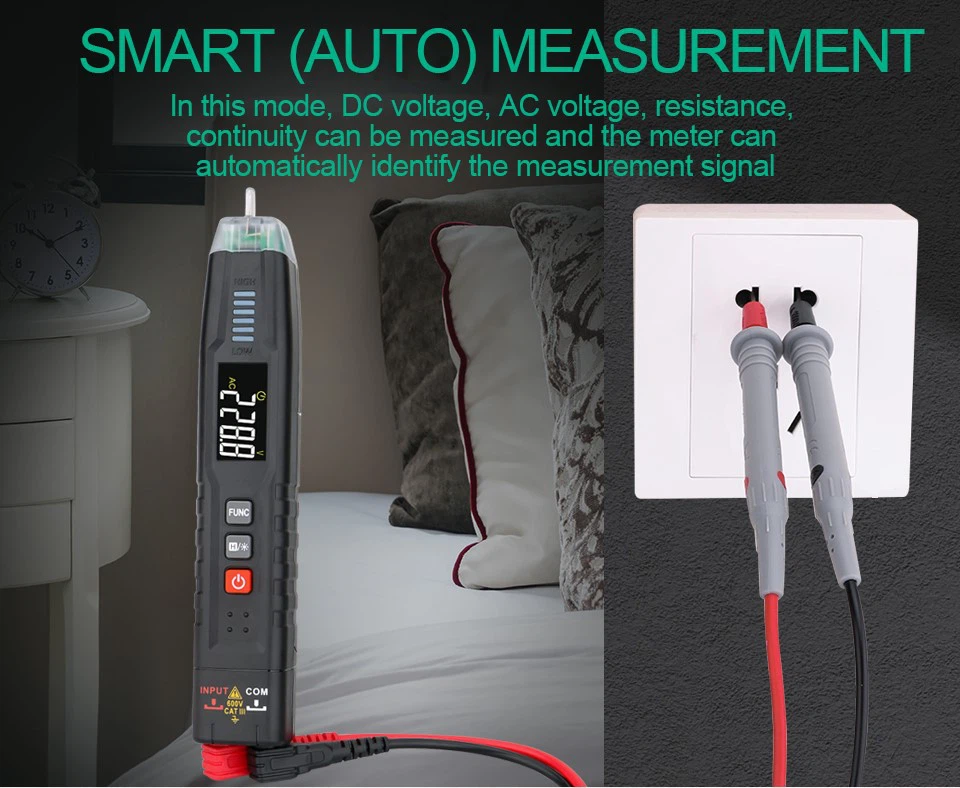
It draws about 8 mA in auto mode, which is probably the mode you’d use the most. Low battery warning around 2.65V and usable down to about 2.3V if you don’t mind the beeper sounding really bad. All of that suggests you might get about 250 hours of runtime out of a pair of AAA alkaline batteries. Not exactly brilliant as multimeters go, but the always-on backlight (which I admit makes it easy to read the screen) isn’t going to do you any favors on runtime.
Phase sequence is kind of an odd feature to throw in. You wouldn’t think anyone doing three-phase work would be using such a cheap meter. I would have much preferred they give me a low-impedance mode instead. Electronicists seem to have driven a lot of people to think that it’s best for your meter to have the highest possible impedance, but in truth for a lot of handyperson type activities it can cause unnecessary confusion. You can end up measuring a “phantom voltage” that almost isn’t really there (in the sense that it can’t source any current to speak of). I suspect (but can’t say for sure because I haven’t gotten my hands on one) that the Klein MM300 would be a better choice in that regard, assuming you can tolerate manual ranging and don’t need to measure capacitance—just going from its resistance measurement range, it probably has a lower impedance. But, of course, if you’re doing fine electronics work then ignore that—you want all the impedance you can get. From teardown photos online, that Klein seems to also have beefier input protection, so I’d feel safer using that one on household mains power. If you’re really looking for something safe, though, the Fluke 101 is probably the safest “budget” meter you can buy (although it costs more than twice as much as this Kaiweets pen). The Ames CM200A also looks like it merits honorable mention in that regard. This GVDA has a couple little PTC’s for overcurrent protection, but no MOV’s that I could see for overvoltage protection. I won’t say that the Cat III safety rating is completely unrealistic, but I’d feel better limiting this meter to Cat II work (i.e., stay away from your main breaker panel—which is pretty good advice for someone with only a handyperson electrical skillset anyway). And a typical homeowner would probably get more mileage out of it if they’d included a dedicated alkaline battery test mode that applies a small load instead of measuring the battery’s resting voltage. Or noncontact voltage detection. And from a throw-it-in-your-bag portability standpoint, you might do well to look at the Uni-T UT10A or Triplett 2030C. So in all this meter occupies a somewhat awkward position in a very crowded market. And this product doesn’t quite seem built to fit any one user demographic to a tee.

This meter does not measure current, which is likely to be problematic if you’re doing fine electronics work but I would argue is actually a good thing for handyperson activities. A handyperson rarely needs to measure current, and blowing the fuse (or worse) on that setting is a common beginner’s mistake that can’t happen here. This is the sort of meter (as is the Fluke 101) that you don’t have to worry too much about handing over to a would-be technician who isn’t exactly the sharpest tool in the shed. That said, working with high-energy electricity is always potentially dangerous, and I implore you to proceed with caution in all things. A lot of troubleshooting can be done without energizing the circuit under test, just using the continuity mode to check the path through an appliance, for example, for any breaks. And it’s always preferable to have something de-energized if possible. Even then, though, there is always some risk. Your home may have been wired oddly, with two circuits sharing a neutral and you only disabled one of them. Or an appliance you unplugged may have a big capacitor (usually a large cylinder) that stores enough energy to shock you despite being unplugged. I would encourage you to de-energize things but still treat them with a level of caution as though they were energized anyway. And call a professional if you aren’t sure you can do the job safely. You can always hover over their shoulder and ask questions so you’re better prepared to try it yourself next time.
GVDA also makes a vaguely similar model, the GD109, with non contact voltage detection and both probes socketed. That loses the advantage in hovering, I-only-have-two-hands scenarios, though, so again I’m not quite sure what market they’re targeting. I imagine both are perfectly fine meters, but they don’t seem to me to have a whole lot that makes me want to say to anyone that this is the one meter you should buy with your finite money supply.
But, that said, this multi meter is very cheap. It’s one of the cheapest meters you’ll find that can measure capacitance, which is probably the most useful feature not generally found on really cheap meters. If your heat pump isn’t working right, a quick reading from this meter and a run to the hardware store for a twenty-dollar replacement part might have you up and running again. And that’s nothing to sneeze at. If you only have twenty-two dollars to spend on a meter for home use, I don’t think I could point you to an overall better product than this one. So I think I have to give it four stars for that reason alone.
On the whole, it’s a pretty decent little low-cost meter.GVDA really seems to be making a name for itself in the budget market, which is nice in a market previously dominated by junk. They haven’t quite hit upon perfection, but I couldn’t fault you at all for buying this product if it suits your purposes. And I will be very interested to see what GVDA comes up with next.