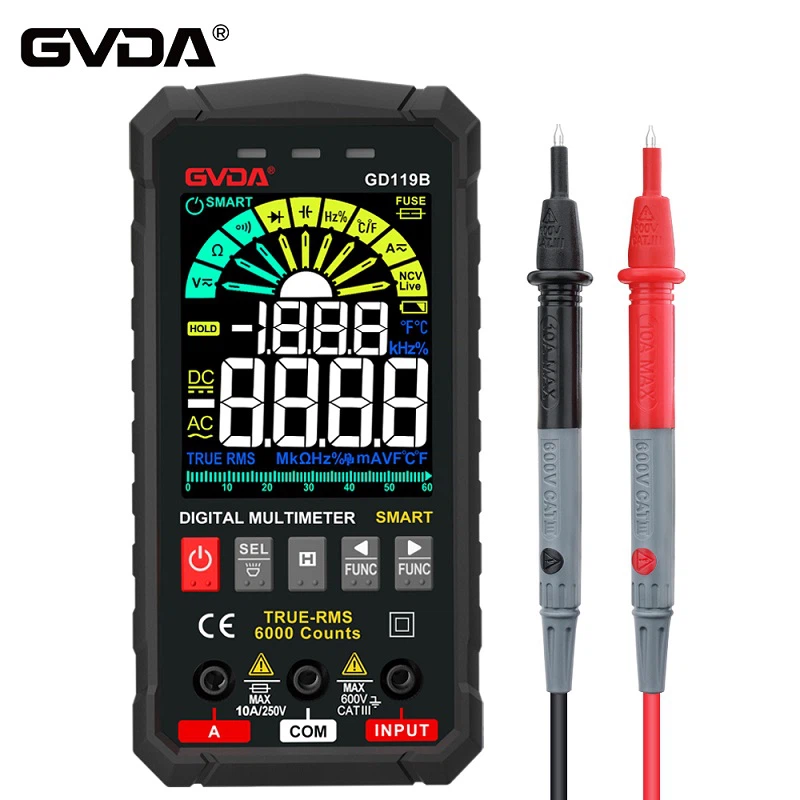
The 9V battery in the multimeter is measured to be 9.3V, so why can’t it carry it?
This should be explained in two aspects. Because 9V stacked batteries are divided into carbon batteries and alkaline batteries!
1. The carbon battery has a large instantaneous current, but not for a long time! The point is cheap! If you don't use it and leave it for a month or two, it will basically consume a lot of power. When you run out of power and the power is low, replace the spare battery and find that it has run out of power after a short period of use. The specific performance is that the multimeter displays it, and there is no word. Turn it off and on again to show it. Take off the measurement voltage, there is 8V voltage.
2. Alkaline batteries have stable output and long life, which is very suitable for multimeters. I have been using carbon batteries before, and I have to use several pieces a year. Since I replaced the alkaline battery of a well-known domestic brand, there has never been a failure like yours. If you think about it, the voltage resistance is being detected, and the multimeter has insufficient power, resulting in a large error. How cheating? The low discharge capacity of alkaline batteries enables them to be stored for a long time. Guaranteed for 10 years, rest assured.
To see if a battery has power, it is not the voltage, but the current. As long as the battery can draw a certain current, the battery can still be used, regardless of the voltage.
Voltage is just a potential difference. It just means that there is a potential difference between these two places. A potential difference does not mean that there must be a current. For example, when a battery is empty, there is of course a potential difference between the two electrodes, but there is no current because there is no conductor formed. circuit.
What if there is a loop? One of the most extreme cases is to directly use a wire (such as copper wire) to connect the two ends of the electrodes. It is said that there should be a large current at this time. After all, the resistance of the conductor (copper wire) is very small. According to Ohm's law, The current is definitely not small, but the actual situation is not like that. This is because the battery itself has a resistance as a power source. This resistance (internal resistance) is very large (relative to the wire), and the current that the battery can provide is also affected by this resistance. restrict.
When the battery is used or left for a period of time, the internal resistance of the battery will increase, and the final result is that it will not be able to draw much current. Although the voltage can be measured at no load at this time, when you connect it When the load draws current, the voltage will drop rapidly due to the internal resistance, eventually causing the battery to fail to supply power normally.
In order to solve this problem, some people used to inject salt water into the battery to reduce the internal resistance, and the power supply capacity of the battery will be restored within a certain period of time. Nothing works anymore.
If your 9V battery is used up quickly, it is recommended that you use rechargeable batteries. Even if you use ordinary batteries, it is recommended that you use the freshest batteries. All batteries have a date of manufacture, but some people will use old batteries or even used batteries to reinstall Dates are stamped on the packaging, so where you buy the battery also matters.