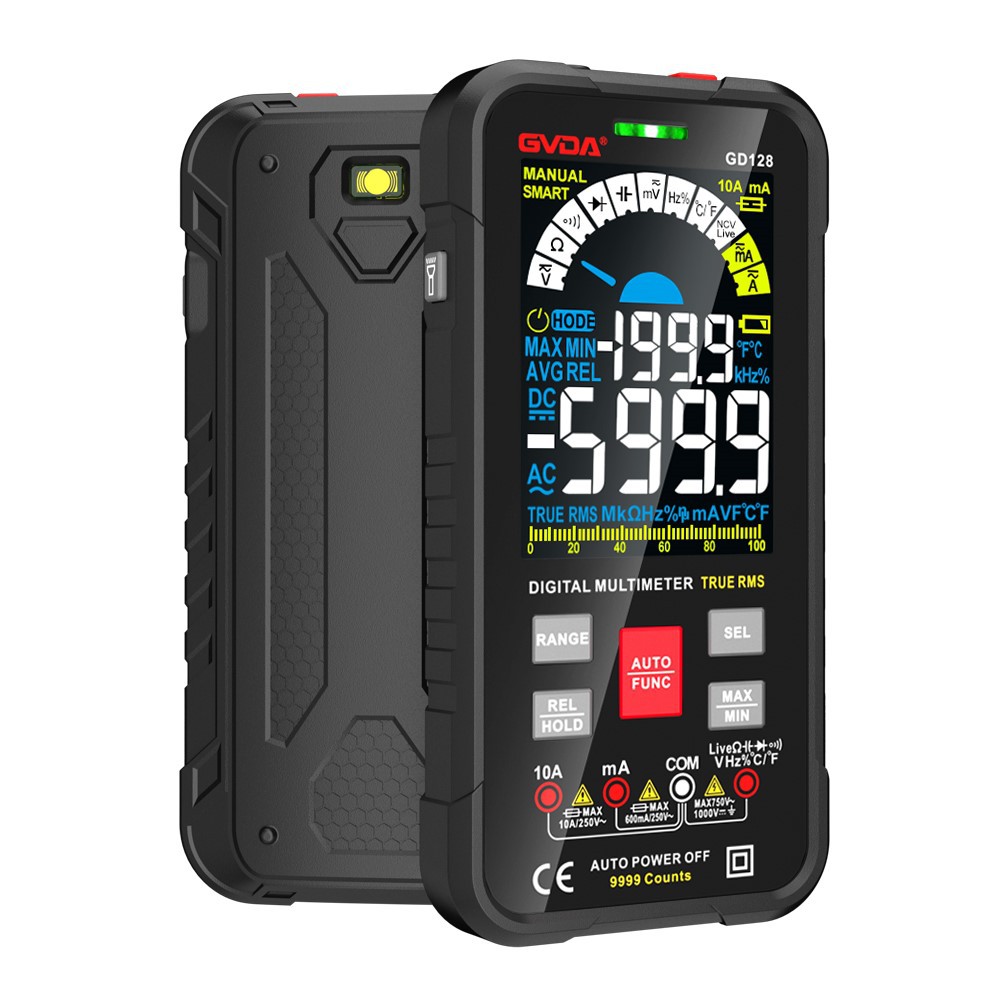
The method of judging the same-name terminal of three-phase asynchronous motor winding by multimeter
Method 1. Triangular Connection Determination
Step 1: Set the multimeter to the R×100 gear, measure the six lead wires of the motor junction box, two by two, and determine the three-phase winding.
The specific method: connect the red (or black) test lead to one of the lead-out lines; the black (or red) test lead contacts the other five lead-out lines in turn; , and make a mark (knotting or coloring is recommended as an identification mark) to distinguish it from the two phases behind, and so on to divide the six lead-out lines into three groups (see Figure 2).
Step 2: Set the multimeter to the current microampere block, and check the wiring as shown in the figure to determine the beginning and end of the two-phase winding.
specific method:
(1) Set the multimeter to the current microamp;
(2) The red and black test leads of the multimeter are connected to the two endpoints of one winding of the motor;
(3) Then contact the two terminals of the other phase of the motor with the negative and positive poles of the battery (or take out the battery in the multimeter for testing) E (9V or 1.5V battery);
(4) If the pointer of the multimeter deflects forward, the terminal connected to the positive terminal of the battery and the negative terminal (black pen) of the multimeter are terminals with the same name. On the contrary, the terminal connected to the negative terminal of the battery and the terminal connected to the negative terminal of the multimeter (black test lead) have the same name. The head end (or tail end) marked with a black dot in the figure is the end with the same name. Use the same method to determine the beginning and end of another phase.
Method 2: Star Connection Determination
Step 1: Determine the three-phase winding (the method is the same as above, note that after each phase is detected, a simple and clear mark should be made; in order to distinguish the three-phase stator winding).
Step 2: Star connection determines the first and last ends of the three-phase winding 1.
specific method:
(1) Set the multimeter to the micro-safety block;
(2) Short connect one end of each of the three windings of the three-phase asynchronous motor to the red test lead, connect the other three ends together, and then connect to the black test lead;
(3) Rotate the motor at a constant speed and observe the deflection of the pointer;
(4) If there is almost no deflection of the pointer, the three wire ends connected together selected by each winding are the end with the same name (as shown in Figure 3). Otherwise, change the line and adjust.
2. Line changing rules:
(1) Mark the first and last of the three windings respectively, and reserve the terminal number.
(2) One of the windings (assumed to be the ⑤-⑥ end) is always fixed as a reference.
(3) After the head-to-tail pairing of any group in the other two groups, judge according to the specific method (1)-(4). If there is still a deflection, then the head and tail of the other group are reversed, and then judged according to the specific method "1)-(4), the correct end with the same name will definitely be able to be judged.
Attached, the junction box diagram of the star and delta connection of the stator winding UI-U2, V1-V2, W1-W2 of the three-phase asynchronous motor is shown in Figure-1. From the diagram, it can be seen that the star connection of the three-phase asynchronous motor is the fixed-hand winding The head end (or tail end) of the three-phase asynchronous motor is connected in a delta connection, and the head end of the stator winding of one phase is connected to the tail end of the fixed hand winding of the other phase. That is to say, whether it is a star connection or a delta connection, the key to repairing the motor is to first determine the three-phase fixed winding of the three-phase asynchronous motor and its head and tail. A method for effectively judging the first and last ends of a three-phase asynchronous motor winding.