The working principle of a multimeter and the function of the panel knob
Basic working principle
There are many kinds of digital multimeters, but the basic working principles are similar to each other. The dotted line box represents the DC digital Voltmeter DVM, which is composed of resistance capacitance filter, A/D converter and LCD display. On the basis of digital Voltmeter, AC DC converter, current voltage (I V) converter and resistance voltage (Ω V) converter are added to form a digital multimeter.
The function of the panel knob
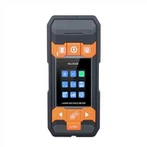
The panel of a multimeter is arranged with five parts: LCD display screen, range switch, input socket, hFE socket, and power switch. The functions of each part are as follows:
(1)LCD display screen: The display digit of a multimeter is 4 digits. Since the highest digit (thousand digits) can only display the number "1" or does not display a number, it is counted as half digit, collectively known as three and a half digits. The maximum number of displays is 1999 or -1999. When measuring DC voltage and DC current, the instrument has an automatic polarity display function. If the measured value is negative, the displayed number will be preceded by a "-" sign. When the instrument input is overloaded, "1" or "-1" appears on the screen.
(2) Range switch: The rotary range switch is located in the center of the panel and is used to convert the type of work and range. Use different colors and boundaries around the switch to mark the range of various working states.
(3) Input socket: The input socket is the part where the multimeter is connected to the measuring point through the probe, and has four holes: "COM", "V. Ω", "mA", and "10A". The negative lead should always be placed in the "COM" socket, while the positive lead should be placed in "V. Ω", "mA", or "10A" depending on the type of work and the size of the measured value. On the connection between "COM" and "V. Ω", there is a mark printed, indicating that when inputting from these two holes, the measured AC voltage should not exceed 750V and the measured DC voltage should not exceed 1000V. At this point, the measurement "V" and "Ω" are both in the same socket, so it is important to carefully check whether the range switch selection position is correct. There are also markings on the wires between "COM" and "mA", as well as between "COM" and "10A", indicating that the measured current values between the corresponding sockets cannot exceed 200mA and 10A.
(4) HFE socket: This socket is used for inserting and placing the transistor under test. When measuring, the e, b, and c pins of the tube should be inserted into the three holes "E", "B", and "C" respectively. "E" has two holes that have the same effect, and the emitter pin can be easily inserted.
(5) Power switch: When the switch is placed in the "ON" position, the power in the meter is connected and can work normally. When the switch is placed in the "OFF" position, the power is turned off.