Using Infrared Thermometer Correctly to Diagnose Equipment Faults
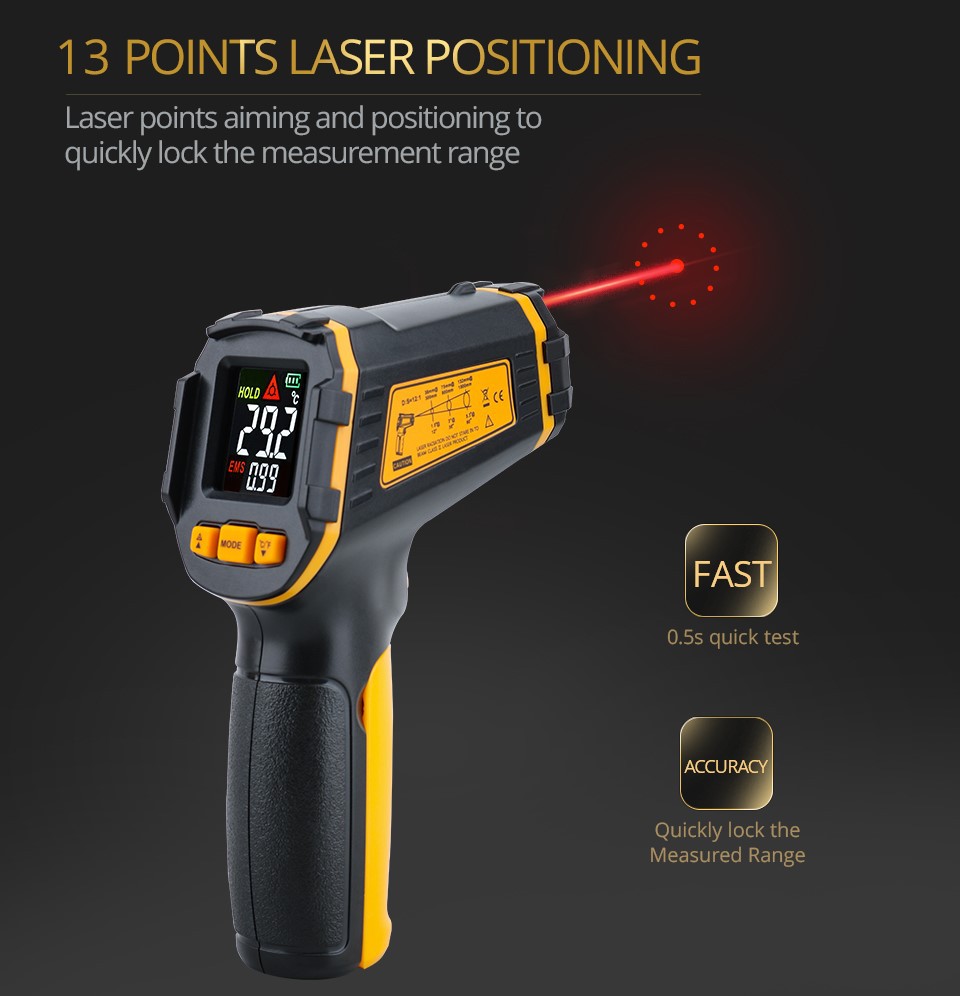
The core problem of infrared diagnosis of equipment faults recommended by infrared thermometers is to accurately obtain the temperature distribution of the tested equipment or the temperature value and temperature rise value of the fault-related points. This temperature information is not only the basis for judging whether the equipment is faulty, but also an objective basis for judging the attribute, location, and severity of the fault. Therefore, the calculation and reasonable correction of the temperature of the fault-related parts of the tested equipment are the key links to improve the accuracy of the surface temperature of the testing equipment. However, when infrared detection of equipment is carried out on site, due to changes in detection conditions and environmental influences, different results may be obtained for the same equipment due to different detection conditions. Therefore, in order to improve the accuracy of infrared detection, it is necessary to take corresponding countermeasures and measures or choose good detection conditions in the process of on-site detection or in the analysis and processing of detection results, or make reasonable corrections to the detection results.
Among them, the influence of the operating state of electrical equipment:
Electrical equipment faults are generally thermal faults caused by current effects (conductive circuit faults - heating power is proportional to the square of the load current value), and thermal faults caused by voltage effects (insulation medium faults - heating power is proportional to the square of the operating voltage Proportional). Therefore, the operating voltage and load current of the equipment will directly affect the effect of infrared detection and fault diagnosis. The increase of the leakage current can cause the partial voltage of the high-voltage equipment to be uneven. If there is no load operation or the load is very low, the equipment failure and heating will not be obvious. Even if there is a serious failure, it is impossible to be exposed in the form of characteristic thermal abnormalities. Only when the equipment is operated at the rated voltage and the load is greater, the heat generation and temperature rise will be more serious, and the characteristic thermal anomaly of the fault point will be exposed more obviously.
In this way, in order to obtain reliable detection results when performing infrared detection, it is necessary to ensure that the equipment operates at rated voltage and full load as much as possible. Before and during the detection process, the equipment can be operated at full load for a period of time, so that the faulty parts of the equipment have enough heating time, and ensure that the surface reaches a stable temperature rise. In the infrared diagnosis of electrical equipment faults, the fault judgment standard is often based on the temperature rise of the equipment at the rated current. current temperature rise.
The infrared measuring instrument on the surface of the equipment obtains the temperature information of the equipment by measuring the infrared radiation power on the surface of the electrical equipment. And when the infrared diagnostic instrument receives the same infrared radiation power from the target, different detection results will be obtained due to the different surface emissivity of the target. That is to say, for the same radiation power, the lower the emissivity, the higher the temperature will be displayed. Because the surface emissivity of an object is mainly determined by the material properties and surface state (such as surface oxidation, coating material, roughness and pollution state, etc.).
Therefore, in order to accurately measure the temperature of electrical equipment using infrared measuring instruments, it is necessary to know the emissivity value of the target to be tested, and input this value into the computer as an important parameter for calculating the temperature or adjust the ε correction value of the infrared measuring instrument so that the measured The temperature output value is corrected for emissivity. Two countermeasures to eliminate the influence of emissivity on the test results: When using an infrared thermometer for measurement, it is necessary to correct the emission, find out the emissivity value of the surface of the device under test and correct the emissivity, so as to obtain reliable temperature measurement As a result, the reliability of detection is improved; for infrared detection of frequent fault equipment components, in order to make the detection results have good comparability, the method of applying appropriate paint can be used to increase and stabilize its emissivity value, so as to obtain the measured The true temperature of the surface of the device.
Effects of Atmospheric Attenuation:
The infrared radiation energy on the surface of the electrical equipment under test is transmitted to the infrared detection instrument through the atmosphere, which will be affected by the absorption attenuation of water vapor, carbon dioxide, carbon monoxide and other gas molecules in the atmosphere combination and the scattering attenuation of suspended particles in the air.