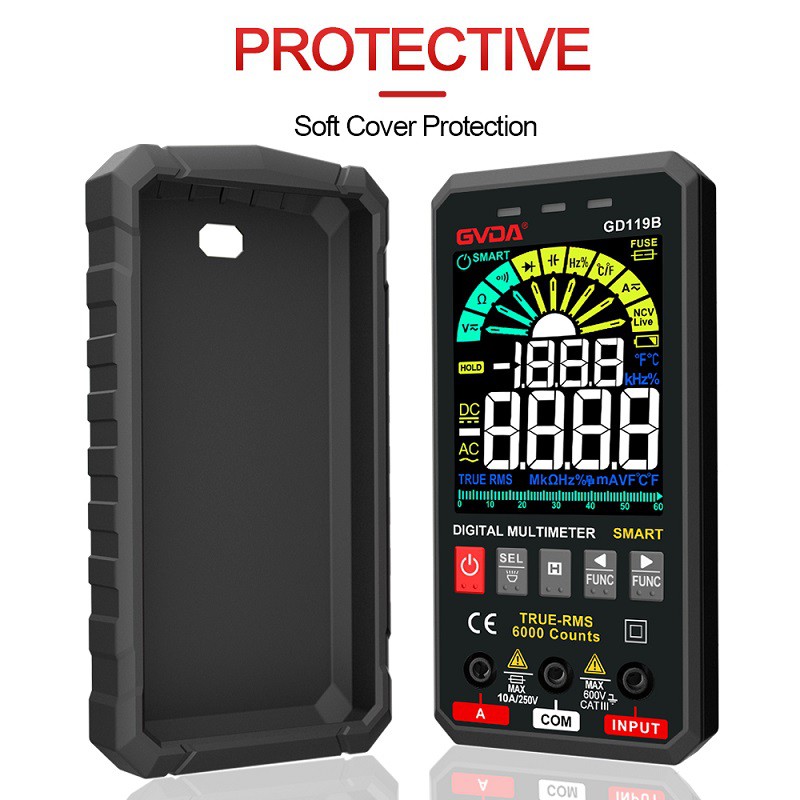
Why can't the multimeter detect the polarity of the alternating current?
Alternating current is a current that changes periodically in size and direction. There is no polarity, only frequency. The frequency of alternating current in my country is 50 Hz, that is, the current changes back and forth 50 times per second, and the direction changes 100 times. This problem itself has problems.
The so-called alternating current means that the polarity changes alternately, and the speed of change is very fast. Whether it is a pointer type or a digital multimeter, it cannot reflect the instantaneous polarity. Its polarity is the number of times it changes within a unit time. The unit of frequency is Hertz, which is a physical unit named in memory of the physicist Mr. Hertz.
The polarity of this power supply changes alternately, and it is impossible to measure its polarity with a general multimeter. If it is necessary to know the polarity at a certain moment, that is, the simplest method for its instantaneous polarity, it needs to be specially used to observe the alternating current. Or an electronic instrumentation oscilloscope for direct current pulses.
The direction of alternating current changes at any time, regardless of polarity. If you want to measure the live wire and the neutral wire, you can turn the multimeter to the highest AC voltage, pinch the black test lead with one hand, and use the red test lead to detect the wire. In addition, some digital multimeters have the function of electroscope pen, which can be used for some common measurement work.
Troubleshooting method of digital multimeter
1. Waveform analysis
Use an electronic oscilloscope to observe the voltage waveform, amplitude, period (frequency), etc. of each key point of the circuit, such as measuring whether the clock oscillator starts to oscillate and whether the oscillation frequency is 40kHz.
If the oscillator has no output, it means that the internal inverter of TSC7106 is damaged, or the external components are open. Observe that the waveform at pin {21} of TSC7106 should be a 50Hz square wave, otherwise the internal 200 frequency divider may be damaged.
2. Measuring component parameters
On-line or off-line measurements of components within the fault range require analysis of parameter values. When measuring resistance online, it is necessary to consider the influence of components connected in parallel with it.
3. Hidden troubleshooting
Hidden faults refer to faults that appear and disappear from time to time, and the instrument is good and bad. This type of failure is more complicated, and the causes of the failure include weak solder joints, looseness, loose connectors, poor contact of the transfer switch, unstable component performance, and continuous breakage of the leads.
In addition, it also includes failures caused by some external factors, such as high ambient temperature, high humidity, or intermittent strong interference signals nearby.
4. Visual inspection
Touch the battery, resistors, transistors, and integrated blocks with your hands to see if the temperature rise is too high. If the newly installed battery heats up, it means that there is a short circuit in the circuit. In addition, it is also necessary to observe whether the circuit is disconnected, desoldered, mechanically damaged, etc.
5. Detect working voltage at all levels
Detect the working voltage of each point and compare it with the normal value. First, ensure the accuracy of the reference voltage. It is best to use a digital multimeter of the same model or similar to measure and compare.