1.5V~30V switching power supply circuit
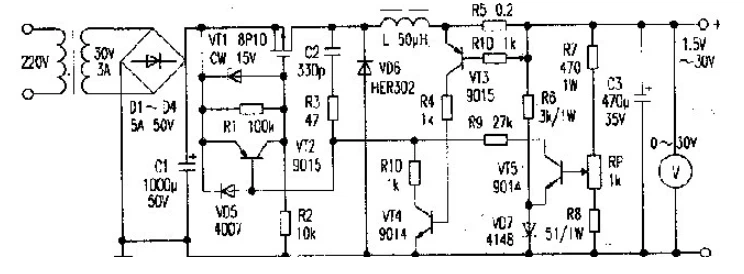
This switch regulates the power supply. It is continuously adjustable from 1.5V to 30V/3A. Limited current short-circuit protection facility, the output voltage is basically unchanged at full load, and its efficiency is above 85%. In addition, an appropriate heat sink needs to be added to the switch tube. See the attached picture for the circuit.
VTl is a switch tube, and VT2 is used for pulse width modulation. VT3 and VT4 form current limiting short circuit protection. VT5 is used as an error amplifier tube. In order to improve the switching frequency, the switch tube VTl adopts VMOS field effect tube. The switching frequency is about 80kHz, which can reduce the size of the inductor L and the output ripple voltage. After turning on the power. The DC voltage rectified by VD1 ~ VD4 produces partial voltage on Rl and R2. CW stabilizes the voltage, this voltage is added to the gate of VTl, VTI is quickly saturated and turned on, and Ui charges C3 through VTI, inductor L, and current-limiting resistor R2. and supply power to the load. At the same time, the collector current of the error amplifier tube VT5 increases, and this current charges C2 through R9 and R3, and the charging polarity of C3 is up positive and down negative. At this time, VT2 is turned on, so VTI is cut off without negative bias voltage. After VTl is cut off, the magnetic energy in the inductor L becomes electric energy with opposite polarity (left negative and right positive), the freewheeling diode VD6 is turned on, and the current continues to supply power to the load through VD6, so that the load obtains a smooth DC. at the same time. C2 changes from a charging state to a discharging state, and the polarity of C2 is up negative and down positive. At this time, VT2 is cut off, and VT1 is quickly saturated and turned on, and the above-mentioned process goes round and round to form an oscillation. Oscillating frequency is determined by C2 and R3, VD5 is anti-parallel connected to VT2 base-emitter two poles to prevent VT2 base-emitter from being broken down by reverse voltage, VD6 is used as reference voltage.
When the output end is short-circuited or the load current exceeds 3A, the voltage generated on R2 makes VT3 conduct, and VT4 also conducts. The modulation tube VT2 is also turned on accordingly, eventually forcing VTl to be cut off, limiting the output of VTl. Thus protecting the VTl.