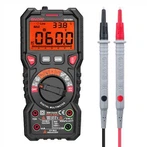
7-point empirical digital formula for using multimeters
1. Before use, you must check whether the function conversion switch is in the corresponding position for the measured power and whether the test leads are in the corresponding jacks.
2. According to the requirements of the "ground" or "arrow" symbol on the meter head, place the multimeter vertically or horizontally. If the pointer does not point at the starting point of the scale, the mechanical zero position must be adjusted first.
3. Select the appropriate range according to the amount of electricity being measured. When measuring voltage and current, try to deflect the pointer to more than 1/2 of the full scale, which can reduce test errors. If you do not know the size to be measured, you can first measure with the maximum range and then gradually reduce the range until the pointer deflects significantly. However, when testing high voltage (above 100 volts) or large current (above 0.5 amps), the range should not be changed while charging, otherwise, the contacts of the transfer switch may catch fire and burn.
4. When measuring DC voltage or DC current, pay attention to the measured polarity. If you do not know the voltage level of the two points to be measured, you can briefly touch the two test leads to the two points, determine the level of the potential according to the direction of the pointer impact, and then measure.
5. When measuring AC voltage, you need to know whether the AC voltage frequency is within the working frequency range of the multimeter. Generally, the working frequency range of a multimeter is 45-1500Hz. Beyond 1500Hz, measurement readings will be sharply low. The AC voltage scale is based on the effective value of the sine wave, so the multimeter cannot be used to measure sine wave voltages such as triangle waves, square sawtooth waves, etc. When AC voltage is superimposed with DC voltage, a DC blocking capacitor with sufficient voltage resistance should be connected in series before measurement.
6. When measuring the voltage on a certain load, it is necessary to consider whether the internal resistance of the multimeter is much greater than the load resistance. If not, the reading value will be much lower than the actual value due to the shunting effect of the multimeter. At this time, the multimeter cannot be used to test directly and should be changed. Use other methods. The internal resistance of the multimeter's voltage block is equal to the voltage sensitivity multiplied by the full-scale voltage value. For example, the voltage sensitivity of the MF-30 multimeter at the DC100 volt block is 5 kiloohms, and the internal resistance of the multimeter is 500 kiloohms. Generally speaking, the internal resistance of the low-range range is small, and the internal resistance of the high-range range is large. When using the low-voltage range to test a certain voltage due to the small internal resistance and the shunt effect is large, you may wish to switch to the high-range test. In this way, although the pointer deflects The angle is small, but due to the small shunting effect, the accuracy may be higher. There is a similar situation when measuring current. When the multimeter is used as an ammeter, the internal resistance is small when using a large range and the internal resistance is small when using a small range.
7. When measuring resistance, zero adjustment is required every time you shift gears. The value of the geometric center of the multimeter's resistance scale multiplied by the multiplier of the electrical barrier is the median resistance of the block, which is equal to the internal resistance of the multimeter in the block. Common center scale values include 8. 10. 12. 13. 16. 20. 24. 25. 30. 60. 75 and so on. The resistance scale is non-linear. When using it, you should choose a suitable gear so that the pointer points as close to the center as possible, usually in the range of 0.1Ro-10Ro (Ro-----median resistance). The reading is more accurate. Outside this range The error is large. For example, the center scale value of the MF10 multimeter is 13. When the Rx10 kilohm block Ro=130 kilohm, this block is suitable for measuring 13 kiloohm-1. 3 megohm resistor.