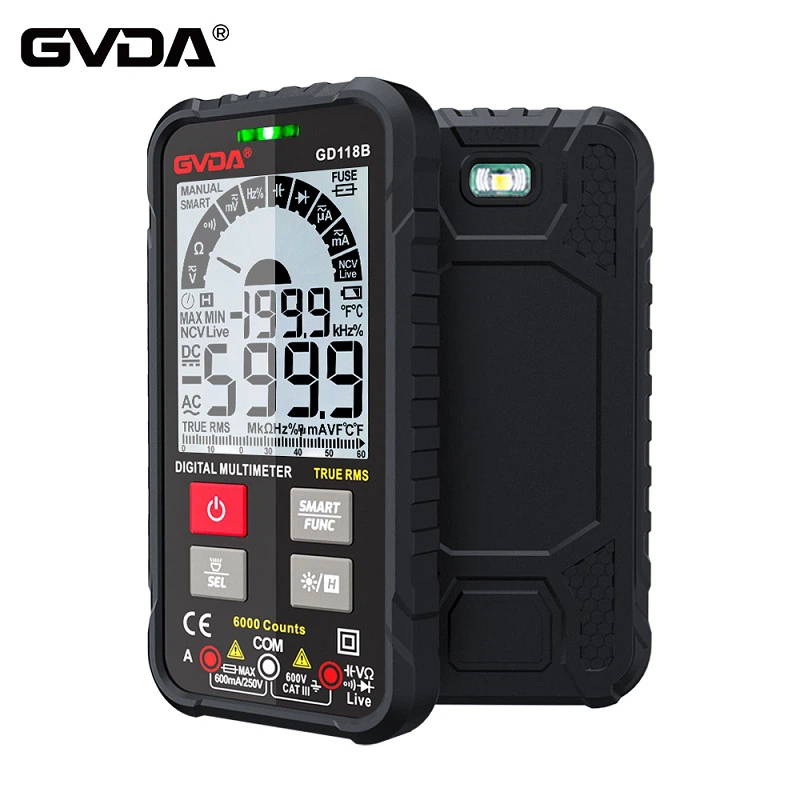
9 requirements for selecting a digital multimeter
(1) Function:
In addition to five functions such as measuring AC and DC voltage, AC and DC current, and resistance, digital multimeter also has functions such as digital calculation, self check, reading maintenance, error reading, diode detection, word length selection, IEE-488 interface or RS-232 interface. When using, it should be selected according to specific requirements.
(2) Range and range:
A digital multimeter has many ranges, but its basic range accuracy is the highest. Many digital multimeters have an automatic range function, which eliminates the need to manually adjust the range, making measurement convenient, safe, and fast. Many digital multimeters also have over range capability, so there is no need to change the range when the measured value exceeds the range but has not reached the maximum display, thereby improving accuracy and resolution.
(3) Accuracy:
The maximum allowable error of a digital multimeter depends not only on its variable error, but also on its fixed error. When choosing, it also depends on the requirements for stability error and linearity error, and whether the resolution meets the requirements. If a general digital multimeter requires a level of 0.000 5 to 0.002, it should have at least 6 and a half digit display; 0.005-0.01 level, with at least 5 and a half digit display; Level 0.02 to 0.05, with at least 4 and a half digit display; Below level 0.1, there should be at least 3 and a half digit display.
(4) Input resistance and zero current:
Both low input resistance and high zero current of a digital multimeter can cause measurement errors. The key lies in the allowable limit value of the measuring device, which depends on the internal resistance of the signal source. When the impedance of the signal source is high, instruments with high input impedance and low zero current should be selected to make their impact negligible.
(5) Serial mode rejection ratio and common mode rejection ratio:
In the presence of various interferences such as electric field, magnetic field and various high-frequency noises or in remote measurement, it is easy to mix interference signals, resulting in inaccurate readings. Therefore, instruments with high serial and common mode rejection ratio should be selected according to the use environment. Especially for high-precision measurement, digital multimeter with protection terminal G should be selected, which can effectively suppress common mode interference.
(6) Display format and power supply:
The display form of a digital multimeter is not limited to numbers, but can also display charts, text, and symbols for on-site observation, operation, and management. According to the external dimensions of its display devices, it can be divided into four categories: small, medium, large, and ultra large.
The power supply for digital multimeters is generally 220 V, while some new types of digital multimeters have a wide power range, which can range from 100 to 240 V. Some small digital multimeters can be used with batteries, while others can be used in three ways: AC, internal nickel cadmium batteries, or external batteries.
(7) Response time, measurement speed, frequency range:
The shorter the response time, the better, but some meters have longer response times and need to wait for a period of time before the reading stabilizes. The measurement speed should be based on whether it is used in conjunction with system testing. When used in conjunction, speed is crucial, and the faster the speed, the better. Select the appropriate frequency range as needed.
(8) AC voltage conversion form:
AC voltage measurement includes average conversion, peak conversion, and effective value conversion. When the waveform distortion is large, the average and peak conversion are not accurate, while the effective value conversion is not affected by the waveform, making the measurement results more accurate.
(9) Resistance wiring method:
There are four wire and two wire wiring methods for resistance measurement. When conducting small resistance and high-precision measurements, a resistance measurement wiring method with a four wire system should be selected.
With the development of large-scale integrated circuits and display technology, digital multimeters are gradually moving towards miniaturization, low power consumption, and low cost. Digital multimeters are also clearly divided into two types: portable and desktop. Portable devices are generally available in 3 and a half or 4 and a half positions, with small size, light weight, and low power consumption, making them suitable for use in production workshops or outdoor environments; The desktop can reach 6 and a half or 7 and a half bits, with increasing accuracy and resolution. It uses microprocessors and GPIP interface devices as standard meters and precision measurements in metrology, scientific research, and production departments.