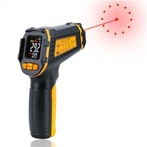
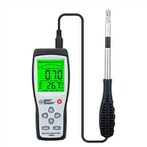
A comparison of the advantages and disadvantages of a conventional multimeter and a digital multimeter:
Analog and digital multimeters each have their own advantages and disadvantages.
The analog multimeter is an average meter with an intuitive and vivid reading indication. (Generally, the reading value is closely related to the pointer swing angle, so it is very intuitive).
A digital multimeter is an instantaneous instrument. It takes a sample every 0.3 seconds to display the measurement results. Sometimes the results of each sampling are only very similar, not exactly the same, which is not as convenient as the pointer type for reading the results. Pointer multimeters generally do not have an amplifier inside, so the internal resistance is small.
Because the digital multimeter uses an operational amplifier circuit inside, the internal resistance can be made very large, often 1M ohm or more. (i.e. higher sensitivity can be obtained). This makes the impact on the circuit under test smaller and the measurement accuracy higher.
Because the internal resistance of the pointer multimeter is small, discrete components are often used to form a shunt and voltage divider circuit. Therefore, the frequency characteristics are uneven (relative to digital), and the frequency characteristics of digital multimeters are relatively better.
The internal structure of the analog multimeter is simple, so it has lower cost, fewer functions, simple maintenance, and strong overcurrent and overvoltage capabilities.
The digital multimeter uses a variety of oscillation, amplification, frequency division protection and other circuits internally, so it has many functions. For example, it can measure temperature, frequency (in a lower range), capacitance, inductance, make a signal generator, etc.
Because the internal structure of digital multimeters uses integrated circuits, they have poor overload capabilities and are generally not easy to repair after damage. Digital multimeters have low output voltages (usually no more than 1 volt). It is inconvenient to test some components with special voltage characteristics (such as thyristors, light-emitting diodes, etc.). The output voltage of the analog multimeter is higher. The current is also large, making it easy to test thyristors, light-emitting diodes, etc.
Beginners should use an analog multimeter, and non-beginners should use both instruments.
Selection principles
1. The reading accuracy of the pointer meter is poor, but the process of the pointer swinging is relatively intuitive, and its swing speed can sometimes reflect the measured size more objectively (such as measuring the slightness of the TV data bus (SDL) when transmitting data). Jitter); the digital meter reading is intuitive, but the process of digital changes looks messy and not easy to watch.
2. There are generally two batteries in an analog watch, one with a low voltage of 1.5V, and one with a high voltage of 9V or 15V. The black test lead is the positive terminal relative to the red test lead. Digital meters commonly use a 6V or 9V battery. In the resistance mode, the output current of the test pen of the pointer meter is much larger than that of the digital meter. Using the R×1Ω gear can make the speaker make a loud "click" sound, and using the R×10kΩ gear can even light up the light-emitting diode (LED).
3. In the voltage range, the internal resistance of the pointer meter is smaller than that of the digital meter, and the measurement accuracy is relatively poor. In some high-voltage and micro-current situations, it is even impossible to measure accurately because the internal resistance will affect the circuit under test (for example, when measuring the acceleration stage voltage of a TV picture tube, the measured value will be much lower than the actual value). The internal resistance of the voltage range of the digital meter is very large, at least in the megohm level, and has little impact on the circuit under test. However, the extremely high output impedance makes it susceptible to the influence of induced voltage, and the measured data may be false in some situations with strong electromagnetic interference.
4. In short, pointer meters are suitable for measuring analog circuits with relatively large currents and high voltages, such as televisions and audio amplifiers. Digital meters are suitable for measuring digital circuits with low voltage and small current, such as BP machines, mobile phones, etc. It is not absolute. Pointer tables and digital tables can be selected according to the situation.