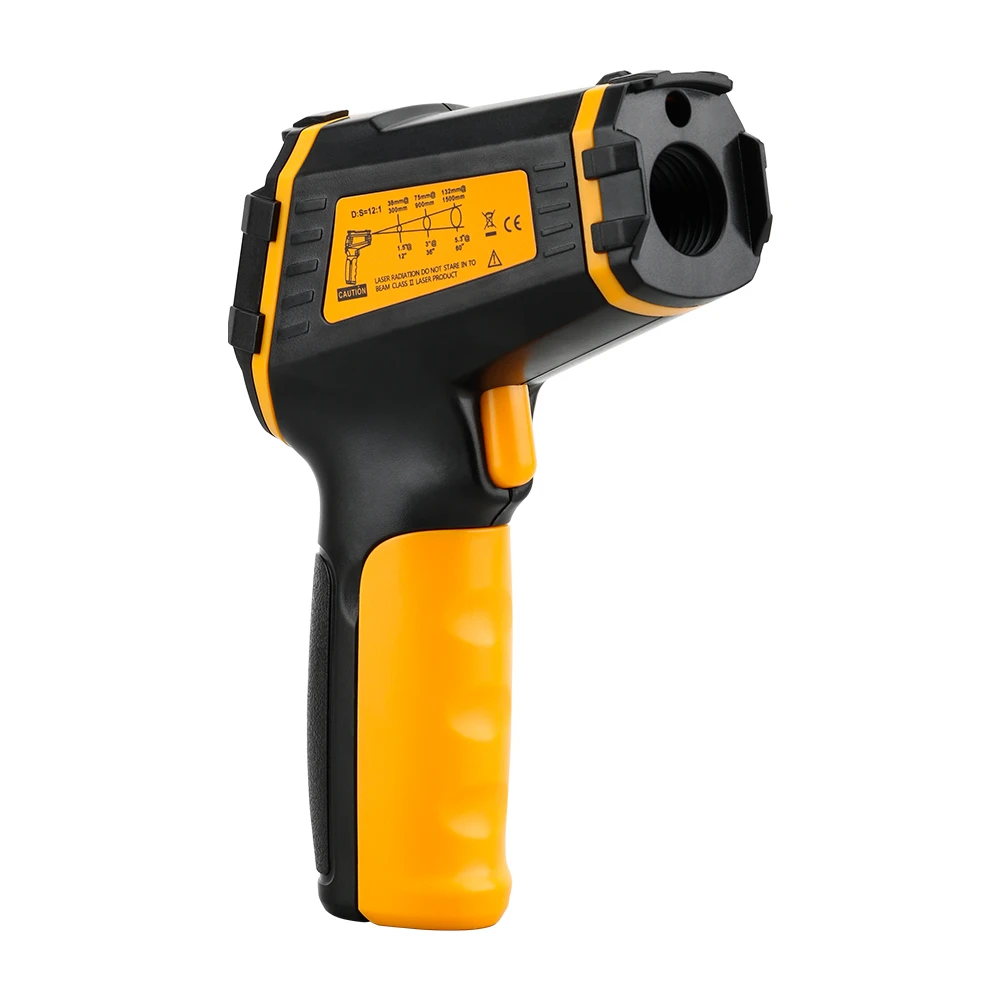
Adjustment of the emissivity of an infrared thermometer
Infrared (IR) radiation
Infrared radiation is ubiquitous and never-ending, and the greater the temperature difference between objects, the more obvious the radiation phenomenon becomes. Vacuum can transmit the infrared radiation energy emitted by the sun through 93 million miles of spacetime to Earth, which is absorbed by us and brings warmth to us. When we stand in front of the food refrigerator in the mall, the infrared radiation heat emitted by our bodies is absorbed by the refrigerated food, making us feel very cool. In both of these examples, the radiation effect is very obvious, and we can clearly feel the changes and feel its presence.
When we need to quantify the effect of infrared radiation, we need to measure the temperature of infrared radiation, and at this time, we need to use an infrared thermometer. Different materials exhibit different infrared radiation characteristics. Before using an infrared thermometer to read temperature, we first need to understand the basic principle of infrared radiation measurement and the specific infrared radiation characteristics of the tested material.
Infrared emissivity=absorbance+reflectance+transmittance
Regardless of the type of infrared radiation, once emitted, it will be absorbed, so absorption rate=emissivity. The infrared thermometer reads the infrared radiation energy emitted from the surface of the object. The infrared radiometer cannot read the infrared radiation energy lost in the air. Therefore, in actual measurement work, we can ignore the transmittance, and thus obtain a basic infrared radiation measurement formula:
Infrared emissivity=emissivity reflectance
Reflectivity is inversely proportional to emissivity, and the stronger an object's ability to reflect infrared radiation, the weaker its own ability to emit infrared radiation. Usually, visual inspection is used to roughly determine the reflectivity of an object. New copper has a higher reflectivity and lower emissivity (0.07-0.2), oxidized copper has a lower reflectivity and higher emissivity (0.6-0.7), and copper that turns black due to severe oxidation has even lower reflectivity and correspondingly higher emissivity (0.88). The vast majority of painted surfaces have a very high emissivity (0.9-0.95), while reflectivity can be ignored.
For the vast majority of infrared thermometers, what needs to be set is the rated emissivity of the tested material, which is usually preset to 0.95, which is sufficient for measuring organic materials or surfaces coated with paint.
The emissivity of a thermometer can compensate for the insufficient infrared radiation energy on the surface of some materials, especially metal materials. The influence of reflectivity on measurement needs to be considered only when there is a high-temperature infrared radiation source near the surface of the measured object that reflects it.