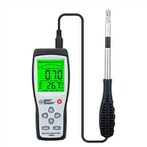
Advantages of the fixed infrared thermometer
Fixed infrared thermometers are an effective tool for detecting and diagnosing faults in electronic equipment. There are many varieties of fixed infrared thermometers, and different series play an important role in their respective industries.
Fixed infrared thermometer technical parameters
1) Temperature range 350--3000℃ (section).
2) Measurement accuracy ±0.5%, ±0.3% (calibration value).
3) Repeat accuracy ±0.1% (calibration value).
4) Response time 10 milliseconds.
5) Spectral response 0.85--1.08 micron; 1.4--1.7 micron.
6) Output mode: linear output, 0-5V; 4-20mA.
7) Ambient temperature optical probe: -15-+75℃; electronic module: 0-+55℃.
8) Environmental humidity ≤90%RH.
9) Storage temperature -30--+85℃.
10) Working power supply ±15VDC0.5A.
11) Load voltage type ≥10KΩ; current type ≤400Ω.
12) Accessory air purifier is available.
Infrared thermometers in the steel industry
Thermometers are used in the steel industry because products are in motion and have very high temperatures. Common steel industry applications are where the temperature is a constant state where molten steel begins to transform into blocks. Reheating the steel to the same temperature is key to preventing it from deforming, and infrared thermometers are used to measure the internal temperature of the regenerator. In high temperature rotary mills, infrared thermometers are used to confirm that product temperature is within rotation limits. In cooling mills, infrared thermometers monitor the temperature of the steel as it cools.
Infrared thermometers in the glass industry
In the glass industry, it is heated to very high temperatures. Infrared thermometers are used to monitor the temperature in furnaces. Handheld sensors detect hot spots by measuring the outside. Measure the temperature of the molten glass to determine the appropriate furnace mouth temperature. In flat glass products, sensors detect the temperature at each processing stage. The wrong temperature or too rapid a temperature change can cause uneven expansion or contraction. For bottle and container products, the molten glass flows to a forehearth that is kept at the same temperature. Infrared thermometers are used to detect the temperature of the forehearth glass. So it should be in the appropriate state at the exit point. In fiberglass products, infrared sensors are used in processing furnaces to detect the temperature of the glass in the forehearth. Another use of infrared sensors in the glass industry is in the process of windshield glass products.