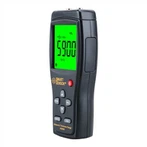
Analysis of the causes of errors in the measurement of anemometers
The anemometer is still a relatively common piece of equipment, but some measurement errors often occur when we operate it. Why does this happen? I believe many people will have this question. Today I will tell you that most of the reasons for measurement errors in anemometers are the following:
1. Installation error
Since the anemometer is an instrument for field use, the environmental conditions during use are far different from those in the laboratory. It can be seen from the working principle of the instrument that before calibration, the rotating axis of the wind speed sensor and the coupling of the anemometer need to be connected with a hose, and the rotating axis of the sensor and the rotating axis of the instrument are required to be strictly concentric. If after installation, there are up, down, left and right If the coupling is eccentric, all the rotational torque of the coupling cannot be transmitted to the rotating shaft of the wind speed sensor, which can easily lead to inflexible rotation and thus bring errors to the measurement results. Therefore, it is necessary to repeatedly adjust the concentricity during installation, and then start the calibration work after the adjustment is completed.
2. Errors caused by unstable wind speed
Due to the circuit principle, if the data is recorded when the data displayed on the anemometer display is not stable, it will bring errors to the measurement results. In order to overcome the influence of this error, the wind speed value must be adjusted and the data displayed on the calibrator display screen should be stable before recording. The stabilization time should be no less than 2 minutes.
3. Errors caused by calibration parameters
The same wind speed sensor has different wind speed equations, and therefore has different calibration parameters. Using a standard to calibrate different types of wind speed sensors requires parameter correction for different wind speed sensors. When performing calibration, attention should be paid to using the dial of the anemometer to input relevant calibration parameters, and check whether the displayed values of the calibrator corresponding to the calibration parameters are correct. If the displayed values are correct, the calibration can be carried out, otherwise measurement errors will occur. .