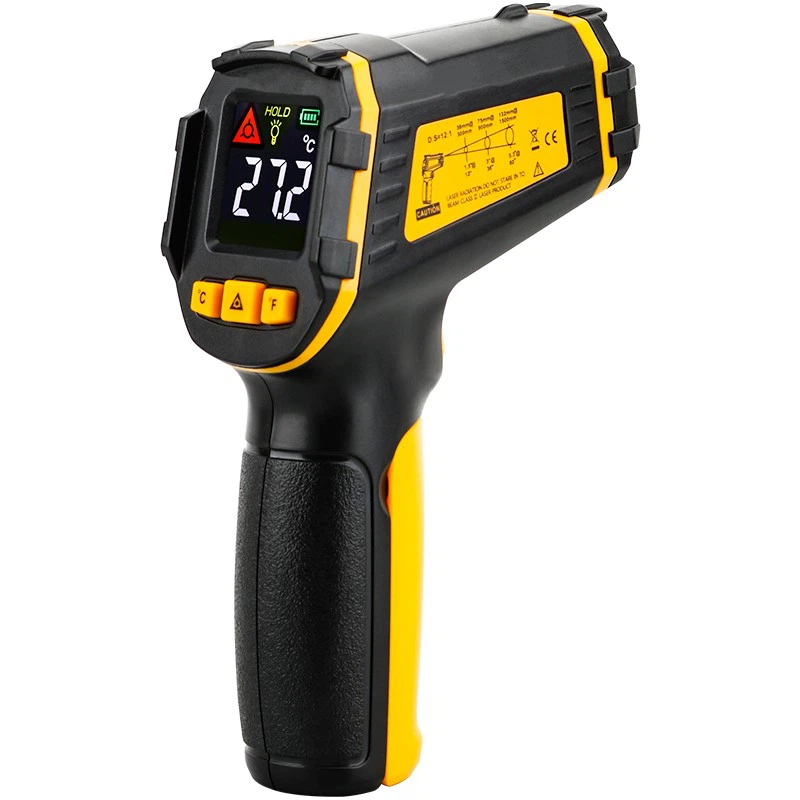
Analyze four factors affecting the measurement of infrared thermometers
1. Relationship Between Target Size and Measuring Distance
The effective measurable diameter of a target varies at different distances. Therefore, attention shall be paid to the measuring distance when testing small targets.The distance coefficient K of an infrared thermometer is defined as the ratio of the measuring distance L to the target diameter D, namely: K=L/D.
2. Selection of Emissivity of the Measured Object
Infrared thermometers are generally calibrated based on a blackbody (emissivity ε=1.00). In practice, the emissivity of all substances is less than 1.00.Accordingly, the emissivity value must be set to obtain the true temperature of the target. The emissivity of various substances can be queried from Data on Object Emissivity for Radiation Temperature Measurement.
3. Target Measurement Under Strong Background Light
If the measured target is exposed to bright background light (especially direct sunlight or strong lamp light), measurement accuracy will be adversely affected.It is recommended to shield the target from direct strong light to eliminate background light interference.
4. Measurement of Small Targets
Aiming and Focusing
Aiming: The small black dot in the eyepiece is the temperature measuring point; align this dot with the measured target.
Focusing: Move the objective lens back and forth until the target is clearly focused.If the target diameter is much larger than the black aiming dot, precise focusing is not required. Refer to the instruction manual for detailed focusing steps.
To ensure accuracy when measuring small targets:
Fix the infrared thermometer on a tripod (optional accessory).
Perform precise focusing: Align the black dot in the eyepiece with the target (the target shall fully cover the aiming dot). Adjust the lens back and forth and shake your eyes slightly. Focusing is completed when there is no relative displacement between the aiming dot and the target.