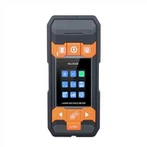
Analyzing the emissivity of an infrared thermometer
Emissivity is the ratio of the radiated energy of an actual object to that of a blackbody at the same temperature under the same conditions. The so-called identical conditions refer to the same geometric conditions (emission radiation area, solid angle size and direction for measuring radiation power) and spectral conditions (spectral range for measuring radiation flux). Due to the correlation between emissivity and measurement conditions, there are several definitions of emissivity.
Hemisphere emissivity is the ratio of the radiant energy flux (emissivity) emitted by a radiator per unit area into hemisphere space to the emissivity of a blackbody at the same temperature. It is divided into two types: total emissivity and spectral emissivity.
Normal emissivity
Normal emissivity is the emissivity measured within a small solid angle in the normal direction of a radiating surface. It is the ratio of the radiance in the normal direction to the radiance of a blackbody at the same temperature. Due to the fact that infrared systems detect radiation energy within a small solid angle in the normal direction of the target surface, normal emissivity is crucial.
For blackbodies, all emissivity values are equal to 1, while for actual objects, all emissivity values are less than 1. The emissivity we currently refer to is the average emissivity.
Regarding emissivity correction:
The emissivity of different object surfaces varies, and in order to ensure the accuracy of temperature measurement, emissivity correction is generally required. Due to the fact that the thermometer is calibrated with a blackbody, the emissivity of any object surface is smaller than that of a blackbody.
The method of emissivity calibration for infrared thermometers is to adjust the amplification factor of the amplifier according to the emissivity of different objects, so that the signal generated by the radiation of an actual object with a certain temperature in the system is the same as the signal generated by a blackbody with the same temperature. For example, if the emissivity of an object is 0.8, the amplification factor of the amplifier needs to be increased to 1/0.8=1.25 times the original. However, in industrial sites, it is generally difficult to determine the target emissivity parameters due to the varying materials, shapes, and surface states of the measurement targets. Measurement errors caused by other factors can lead to differences between measured values and true values. The introduction of emissivity parameter adjustment can effectively solve this problem without affecting measurement linearity. Based on experience temperature or process temperature, adjust according to the following steps:
For example, the range of the thermometer is 500-1400 ℃
The actual temperature is 1200 ℃, and the measured temperature is 1150 ℃,
At this point, the emissivity parameter can be adjusted to:
(1150-500)÷(1200-500)=0.928≈0.93
After such adjustments, the measured values are closer to the true values, and can also be adjusted according to the "Material Radiation Coefficient Table". But the parameters in this table may not be applicable to the process requirements. It must be clarified that the essence of emissivity adjustment is to correct measurement errors.