Anemometer's thermal probe principle
The basic principle of an anemometer is to place a thin metal wire in a fluid, and heat the wire through an electric current to make its temperature higher than that of the fluid, so the wire anemometer is called a "hot wire". When the fluid flows through the wire in the vertical direction, it will take away part of the heat of the wire and reduce the temperature of the wire. According to the theory of forced convection heat exchange, there is a relationship between the heat Q lost by the hot line and the velocity v of the fluid. A standard hot wire probe consists of a short, thin wire stretched between two brackets. Metal wire is usually made of platinum, rhodium, tungsten and other metals with high melting point and good ductility. The commonly used wire has a diameter of 5 μm and a length of 2 mm; a small probe has a diameter of only 1 μm and a length of 0.2 mm.
According to different purposes, the hot wire probe is also made into double wire, triple wire, oblique wire, V shape, X shape, etc. In order to increase the strength, sometimes a metal film is used instead of a metal wire, and a thin metal film is usually sprayed on a thermally insulating substrate, which is called a hot film probe, as shown in Figure 2.2. Hot wire probes must be calibrated before use. Static calibration is carried out in a special standard wind tunnel, and the relationship between flow velocity and output voltage is measured and drawn as a standard curve; dynamic calibration is carried out in a known fluctuating flow field, or in the heating circuit of the anemometer. Check the frequency response of the hot-wire anemometer with the last pulsating electrical signal. If the frequency response is not good, it can be improved with the corresponding compensation circuit.
The measurement range of flow velocity from 0 to 100m/s can be divided into three sections: low velocity: 0 to 5m/s; medium velocity: 5 to 40m/s; high velocity: 40 to 100m/s. The thermal probe of the anemometer is used for the measurement of 0 to 5m/s; the rotary probe of the anemometer is ideal for measuring the flow velocity of 5 to 40m/s; and the pitot tube can be used to obtain results in the high-speed range. An additional criterion for the correct selection of the flow rate probe of the anemometer is the temperature. Usually, the temperature of the thermal sensor of the anemometer is about +-70C. The rotor probe of the special anemometer can reach 350C. Pitot tubes are used above +350C.
Thermal probes for anemometers
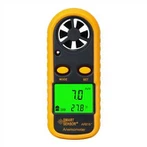
The working principle of the thermal probe of the anemometer anemometer is based on the cold impact airflow taking away the heat on the heating element. With the help of an adjustment switch to keep the temperature constant, the adjustment current is proportional to the flow rate. When using thermal probes in turbulent flow, airflow from all directions impinges on the thermal element simultaneously, which can affect the accuracy of the measurement results. When measuring in turbulent flow, the indication value of the thermal anemometer flow sensor is often higher than that of the rotary probe. The above phenomenon can be observed in the pipeline measurement process. Depending on the design of the managed pipe turbulence, it can occur even at low speeds. Therefore, the anemometer measurement process should be carried out on the straight part of the pipeline. The starting point of the straight line should be at least 10×D (D=pipe diameter in CM) before the measuring point; the end point should be at least 4×D behind the measuring point. The flow section must not be obstructed in any way. (angles, resuspensions, objects, etc.)
The working principle of the rotating wheel probe of the anemometer is based on converting the rotation into an electrical signal. First, it passes through a proximity sensor to "count" the rotation of the rotating wheel and generate a pulse series, which is then converted by the detector. Get the speed value. The large-diameter probe (60mm, 100mm) of the anemometer is suitable for measuring turbulent flow with medium and small flow rates (such as at the outlet of the pipeline). The small-caliber probe of the anemometer is more suitable for measuring the airflow where the cross-section of the pipe is more than 100 times larger than the cross-section of the probe.