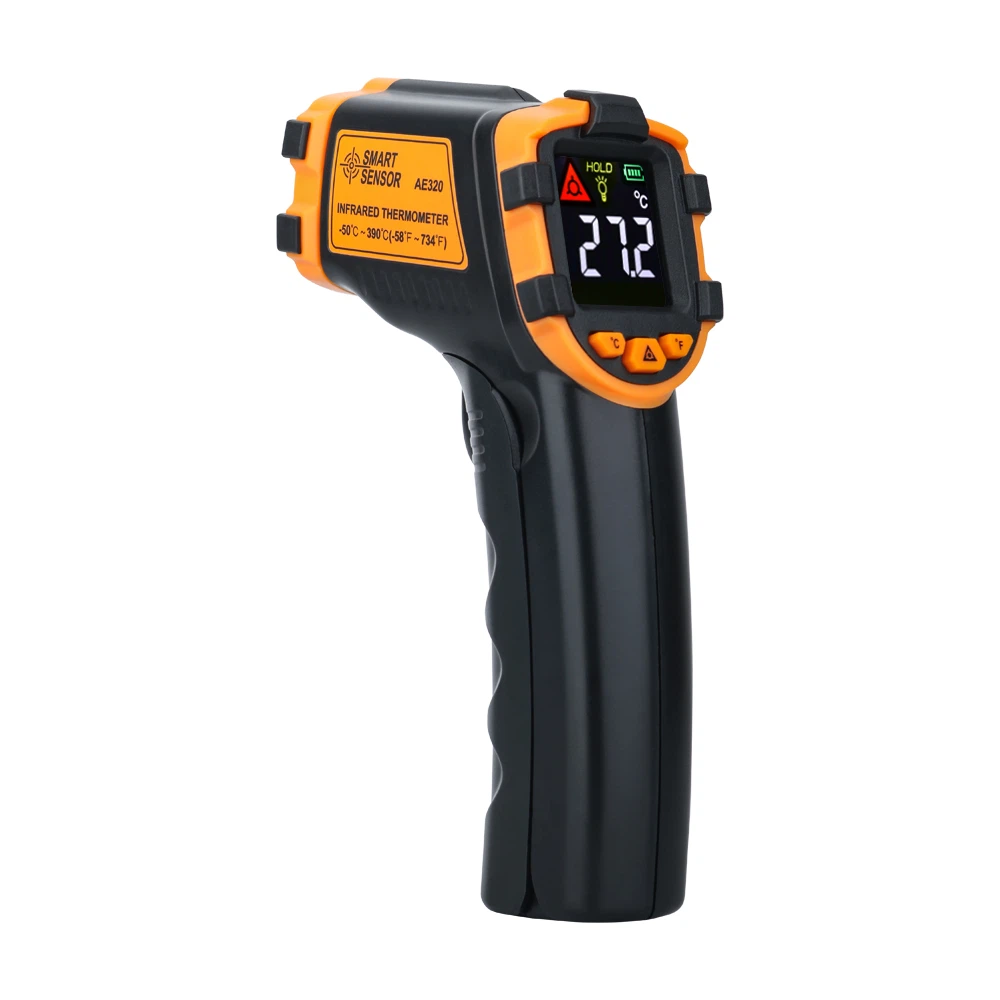
Application of Infrared Thermometers in Factories
Temperature, pressure, current, voltage, and other basic physical quantities are familiar to people. In the industrial field, the quality of products and the control of the entire process have a significant impact. Among these basic physical quantities, measuring and calibrating temperature is much more difficult. This is because the effects of the "adiabatic" and "heat transfer" of the temperature system itself are very complex, which results in a large volume of temperature measurement calibration system, long stability time required, and difficulty in improving accuracy. Unlike pressure systems, it is not enough to ensure that the internal and external pressures do not affect each other as long as the pressure transmission pipeline leaks. This makes it easy to achieve rapid pressure transmission, with a stable time of only a few milliseconds and measurement accuracy easily reaching over ten thousandths.
Let's take a look at a high-precision and high stability temperature measurement system again. It is impossible to ensure its "insulation", which means completely preventing heat transfer. People usually assume that the temperature gradient of a small volume at the center of its internal mass is sufficiently balanced when a sufficiently large volume reaches thermal equilibrium, which is one of the important reasons why the temperature calibration source has a large volume. In addition, the heat transfer of a temperature system is also very complex, often completed through heat conduction, convection, and radiation. It can be imagined that it is almost impossible to suddenly change its temperature and reach thermal equilibrium. This is because conventional temperature calibration sources have a large volume and long rise and fall times to ensure a certain degree of temperature field uniformity, resulting in time-consuming, labor-intensive, and expensive inspection, maintenance, and calibration of temperature measurement systems in the industrial field, and the reliability of the system is affected by multiple disassembly and installation of temperature probes.
The industrial field hopes to have a small and lightweight portable temperature calibration source (constant temperature bath) similar to a pressure calibrator. However, this small and portable temperature calibrator must overcome the drawbacks of poor temperature field uniformity and stability caused by reduced volume. In order to achieve stable temperature rise and fall in a short period of time, there must be close coordination between heating and cooling, both of which can reduce the heating and cooling time. Cooling and heating in a miniaturized constant temperature bath also affect the uniformity of the temperature field. Therefore, considering various factors, a portable temperature calibrator with a certain degree of volume and rapid temperature rise and fall is a field application instrument that has been explored and developed for many years in the field of temperature measurement technology.