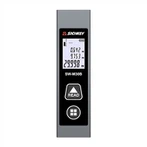
Application of ppm in distance meter measurement
1mm+1ppm is the usual abbreviation of 1mm+1ppm×D (kilometer), which reflects the nominal ranging accuracy of a total station or rangefinder. in:
1mm represents the fixed error of the instrument, which is mainly caused by the measurement error of the instrument plus constant, the centering error, and the phase measurement error. The fixed error has nothing to do with the measured distance. That is, no matter how far the actual distance is measured, the total station will have a fixed error no greater than this value.
1ppm × D kilometers represents the proportional error, where 1 is the proportional error coefficient, which is mainly caused by instrument frequency error and atmospheric refractive index error. ppm means parts per million, and D is the actual distance measured by the total station or distance meter, in kilometers. As the actual measurement distance changes, the proportional error part of the instrument also changes proportionally. For example, when the distance is 1 km, the scale error is 1mm.
For a total station or distance meter with a ranging accuracy of 1mm+1ppm, when the measured distance is 1 km, the ranging accuracy of the instrument is 1mm+1ppm×1(kilometer)=2mm, that is to say, the entire The station measures a distance of 1 km, and the maximum distance measurement error is no more than 2mm.
3 seconds is the distance measurement time
Technical indicators and functions of photoelectric rangefinder
The maximum measuring range of the short-range infrared photoelectric rangefinder is 2 500m, and the ranging accuracy can reach ±(3mm+2×10⁻⁶×D) (where D is the measured distance); the minimum reading is 1 mm; the instrument is equipped with automatic The light intensity adjustment device can also manually adjust the light intensity when measuring in complex environments; the temperature, air pressure and prism constant can be input to automatically correct the results; the vertical angle can be input to automatically calculate the horizontal distance and height difference; the distance can be preset Carry out alignment and stakeout; if you input the coordinates and elevation of the measuring station, the coordinates and elevation of the observation point can be automatically calculated. The ranging methods include normal measurement and tracking measurement. The normal measurement takes 3 seconds, and the average value of several measurements can be displayed. The tracking measurement takes 0.8 seconds, and the ranging is automatically repeated at certain intervals.