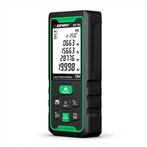
Basic principles of laser rangefinders
1. Principles of distance measurement using infrared or laser light
The principle of distance measurement can be basically reduced to measuring the time required for the light to travel to and from the target, and then through the speed of light c = 299792458m/s and the atmospheric refraction coefficient n to calculate the distance D. Due to the difficulty of measuring the time directly, it is usually determined by the phase of the continuous wave, known as phasor rangefinder. Of course, there are also pulsed rangefinders.
Note that phasorimetry does not measure the phase of the infrared or laser, but rather the phase of the signal modulated on top of the infrared or laser. The construction industry has a hand-held laser rangefinder for house measurements, which works on the same principle.
2. The plane of the measured object must be perpendicular to the light.
Usually precision ranging needs to be fully reflective prisms with the housing measurement with the rangefinder, directly to the smooth wall reflection measurement, mainly because the distance is relatively close, the light reflected back to the signal strength is large enough. With this can be known, must be vertical, otherwise the return signal is too weak will not be able to get an accurate distance.
3. Can measure the object plane for diffuse reflection
Usually can be, the actual project will use a thin plastic plate as a reflective surface to solve the serious problem of diffuse reflection.
4. Pulse method laser rangefinder recreational grade products can achieve display accuracy of 1 metre, measurement accuracy of ± 1 metre, measurement grade products display accuracy of 0.1 metre, measurement accuracy of ± 0.15 metres.
5. Phase type laser rangefinder accuracy can reach 1mm error, suitable for a variety of high-precision measurement purposes.