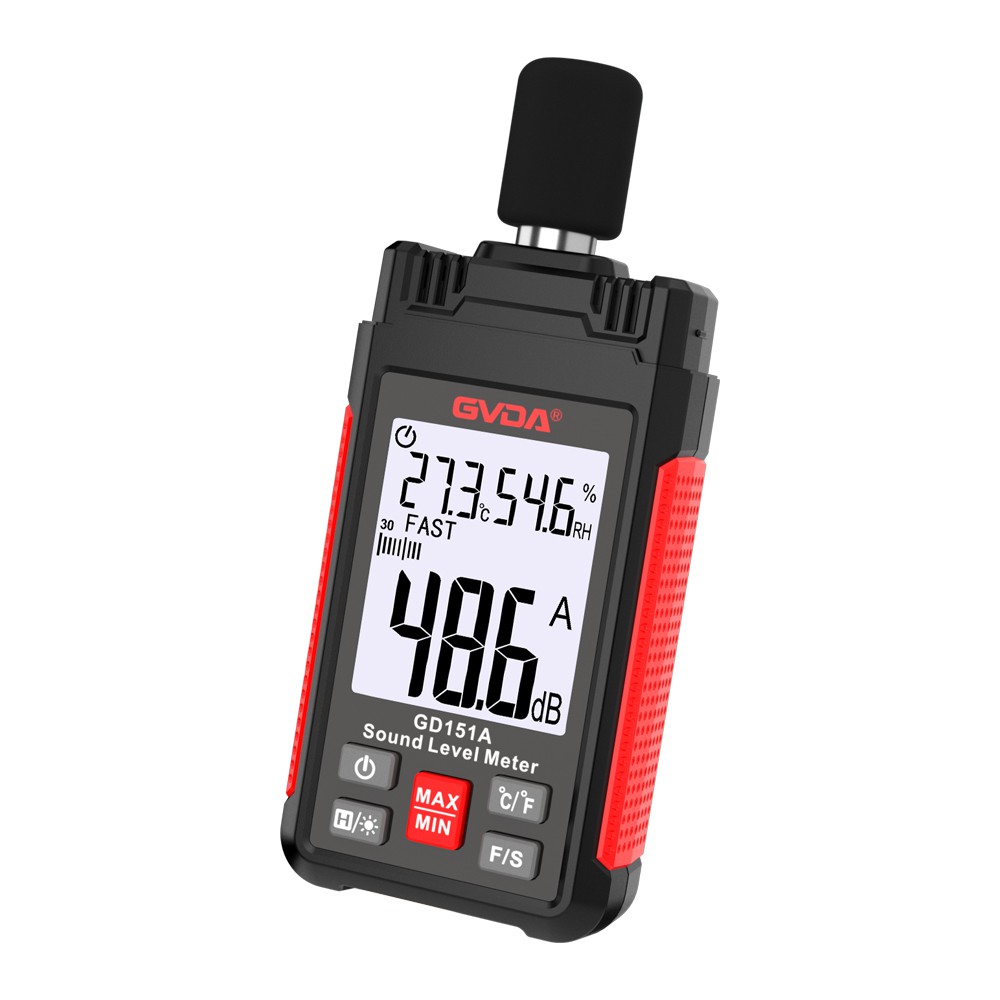
Block Diagram of Sound Level Meter Principle
1. Microphone unit
The microphone unit consists of a microphone and a preamplifier. A microphone is a transducer that converts sound signals into electrical signals, requiring a wide frequency range, flat frequency response, low distortion, large dynamic range, and especially good stability. The preamplifier plays a role in impedance transformation, requiring high input impedance and low output impedance for connection with long extension cables.
2. Enlarge the analysis unit
The amplification analysis unit should have amplifiers and frequency weighting networks, etc. The amplifier circuit amplifies the weak signal from the microphone unit to achieve a certain amplitude, requiring a certain amplification amount, dynamic range, wide frequency range, etc., and ensuring that the amplifier reflects the size change of the input signal without distortion throughout the entire measurement range to ensure the accuracy and reliability of the measurement. The weighted network uses an electric network to simulate the loudness perception characteristics of the human ear. The country has established three curves corresponding to different loudness levels, where A weighting simulates the response of the human ear to a 40 square meter pure tone, B weighting simulates the response of the human ear to a 70 square meter pure tone, and C weighting simulates the response of the human ear to a 100 square meter pure tone. Due to the fact that the noise level measured by the A-weighted network is closer to the human ear's perception of noise, A-weighted sound level is often used to represent the magnitude of noise level in noise measurement. Some sound level meters also have D weighting, mainly used for measuring aviation noise.
3. Display instrument unit
Including detection circuit, indicator circuit, etc. The detection circuit detects the corresponding AC signal from the AC amplifier, and outputs a DC voltage corresponding to the linear variation of the measured sound level from the DC amplifier. The detection circuit includes peak value, average value, and effective value detection circuits. In sound level measurement, the most commonly used is the effective value detection circuit. The results measured by the sound level meter are indicated on the indicator, which has two types: analog indicator and digital indicator. The indication circuit should also have "fast" and "slow" time weighting characteristics.
4. Filters and Spectrum Analysis
For noise, it is composed of many frequency components. In many cases, it is not enough to just know its total sound level. It is also necessary to know its frequency component distribution, that is, to know its spectrum. For general noise analysis work, satisfactory results can be obtained using an octave band filter. The host can directly perform automatic sampling calculation and octave band automatic scanning measurement according to the pre-set measurement method and center frequency filter of the octave band filter. After the measurement is completed, the spectrum chart and data can be printed.