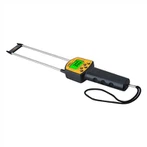
How to Perform Maintenance and Inspection of Gas Detectors?
1. The method of observing and discovering faults through human eyes is called the observation method. This method is mainly used to check for parts deterioration and damage, circuit board solder leakage, virtual soldering, short circuits between wires, wire breakage, and component soldering errors.
2. The touch method is a method of indirectly determining the faulty part by touching the molded components with human fingers or other parts, in order to detect whether the components are overheated or should be heated but not, such as power transformers and electronic tubes that should be heated.
3. The static measurement method mainly uses a multimeter to measure the DC working voltage and phase current in the circuit, in order to determine the fault. Delay is a commonly used method for troubleshooting, which is particularly important for testing linear circuits.
4. The dynamic observation method is a method of finding and eliminating faults by observing the waveform of relevant points through a pointer.
5. The tracking method, which discovers a clue during the process of searching for faults and follows it down, is called the tracking method.
6. The segmentation method is a method of gradually narrowing down the scope of a fault by unplugging a part of the circuit board, disconnecting a part of the circuit board, or breaking a wire on the circuit board during the process of finding a fault, and finally isolating the fault point.
7. The replacement method, which involves replacing thin wires, circuit boards, electronic tubes, or other components to determine the extent of a fault, is called the replacement method.
8. The simulation method is a technique used to identify faults by comparing the data obtained from testing the similarities between a fault free instrument and a faulty positive instrument.
9. In the process of searching for faults, if through measurement and analysis, several reasons can cause such faults, then at this time, one method can be used to troubleshoot first. If it is ineffective, another method can be used to troubleshoot, which is called the probing method.
10. Local heating method instruments malfunction due to increased humidity, which is usually eliminated by local heating. For example, one of the instruments cannot work properly at a temperature of 40 ℃, but it can work normally again after the temperature drops. This team can restore the instrument to room temperature and use an electric hair dryer or soldering iron to locally expose it to the pool to detect the fault, which is called the local heating method.