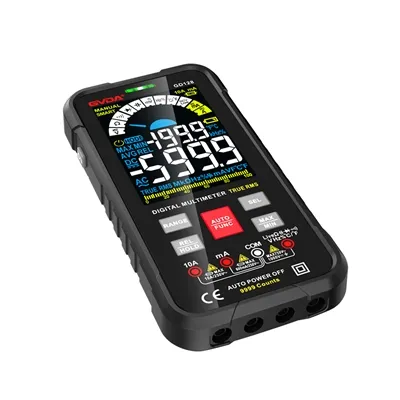
Clamp grounding resistance tester and multimeter difference
1. Appearance inspection: there should be no damage and other defects. In particular, pay attention to the jaw closure should be tight. The iron core part should be free of rust, no dirt.
2. If the mechanical pointer type grounding resistance clamp meter, the pointer should point to "0". Otherwise, it should be adjusted to "0" position.
3. Estimate the size of the measured current, select the appropriate gear, the principle of gear selection is: adjusted in greater than the measured value. And and close to the block.
Open the jaws when measuring. The measured wire clamped into the jaws, close the jaws, the needle deflection. Can read out the measured current value. Before reading should be as far as possible to make the grounding resistance clamp meter table level (mechanical pointer type grounding resistance clamp meter). Digital earth resistance clamp meter does not matter.
Measurement should be noted
1. Test should be loaded with gloves (insulated gloves into clean and dry wire gloves). If necessary, there should be a guardian.
2. Need to change gear when measuring, you should first exit the wire from the jaws. Shift and then clamp into the wire measurement.
3. The voltage of the measured wire. Can not exceed the voltage level of the earth resistance clamp meter.
4. Poor insulation and conductors are prohibited to use the grounding resistance clamp meter measurement.
5. When measuring, pay attention to maintain a safe distance from the nearby charged body. And should be careful not to cause phase-to-phase short circuit and relative ground short circuit.
6. High-temperature environment is not suitable for measuring line current. Strong magnetic fields should not be measured near the external magnetic field on the measurement of the value of the impact is very large, grounding resistance clamp meter should not be in the busbar and large-capacity motors, transformers and other high-current load equipment next to the measurement. Should be measured in a different place to reduce the error caused by magnetic field short circuit.
7. Wet places and thunderstorms should not be measured, because the grounding resistance clamp meter must be hand-held direct measurement, the operation of electrical equipment. Measurement of grounding resistance clamp meter jaws, handles, and measurement of personnel's hands must be kept clean and dry.
8. Ground resistance clamp meter to measure non-work current error. Ground resistance clamp meter principle of work decided to use in the specified amount of rate of grounding resistance clamp meter in addition to measuring sinusoidal current, the measurement of other waveforms of current will produce errors, generally odd harmonic waveforms than even spectral waveform error. Especially the 3rd harmonic error becomes larger, with the grounding resistance clamp meter to measure the half-wave rectifier current, the error is also larger.
9. After use, it should be placed in the current high gear, and when there is a meter set, it will be placed in the meter set. Stored in a dry, dust-free, non-corrosive gas and vibration-free place.
10. Do not measure high-voltage current, the voltage of the circuit to be measured can not exceed the rated voltage of the earth resistance clamp meter. Ground resistance clamp meter can not measure high-voltage electrical equipment.
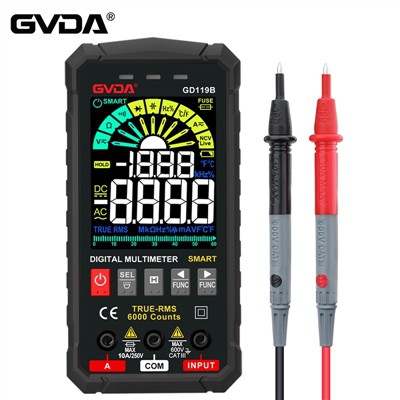
Multimeter has a multi-purpose, wide range, easy to use and other advantages, is more commonly used in the measurement of electrician tools, electrical maintenance work it can be used to measure resistance, AC and DC voltage and DC current, some multimeter can also measure the main parameters of the transistor and capacitor capacitance and so on.