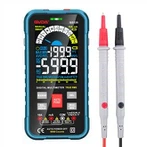
Clamp meter working principle and precautions
How a clamp meter works
A clamp meter is an instrument that integrates a current transformer and an ammeter, and its working principle is the same as that of a current transformer to measure current. The clamp meter consists of a current transformer and an ammeter. Tighten the wrench to open the iron core of the current transformer; the wire through which the measured current passes can pass through the opening of the iron core without being cut off, and the iron core is closed when the wrench is released. The circuit wire under test passing through the iron core becomes the primary coil of the current transformer, where the current is induced in the secondary coil by the passing current. In this way, the ammeter connected to the secondary coil will have an indication ----- measure the current of the line under test.
The clamp meter can be changed to different ranges by means of the toggle switch. However, live operation is not allowed when shifting gears. The accuracy of the clamp meter is generally not high, generally 2.5 to 5 grades. For the convenience of use, the instrument is also equipped with switches of different ranges for measuring different levels of current and measuring voltage.
The clamp meter was originally used to measure AC current, and now the multimeter has all its functions. It can measure AC and DC voltage, current, capacitance, diode, triode, resistance, temperature, frequency, etc.
How to use the clamp meter
(1) Mechanical zero adjustment is required before measurement
(2) Select the appropriate range, first select the large range, then select the small range or look at the nameplate value for estimation.
(3) Use the minimum range measurement, when the reading is not significant, you can wind the line under test a few times, the number of turns is based on the number of turns at the center of the jaw, and then the reading = indicated value × range / full deviation × number of turns
(4) After the measurement is completed, the transfer switch should be set to the maximum range.
(5) When measuring, the wire to be measured should be in the center of the jaws, and the jaws should be closed tightly to reduce errors.
Clamp Meter Precautions
(1) The voltage of the circuit under test should be lower than the rated voltage of the clamp meter.
(2) When measuring the current of the high-voltage line, wear insulating gloves, wear insulating shoes, and stand on the insulating pad.
(3) The jaws must be tightly closed, and the range cannot be changed when electrified
The use and precautions of using an electrician to measure the clamp meter
Clamp-on ammeters are divided into two types: high-voltage and low-voltage, and are used to directly measure the current in the line without interruption. Its usage is as follows:
(1) When using a high-voltage clamp meter, pay attention to the voltage level of the clamp-type ammeter, and it is strictly forbidden to use a low-voltage clamp-type meter to measure high-voltage current. voltage loop. When measuring with a high voltage clamp meter, it should be operated by two people. Off-duty personnel should also complete a second worksheet. Wear insulating gloves when measuring, stand on the insulating pad, and do not touch other equipment to prevent short circuit or grounding.
(2) When observing the time of the watch, special attention should be paid to maintaining a safe distance between the head and the live part. The distance between any part of the human body and the charged body should not be less than the full length of the clamp meter.
(3) When measuring on high-voltage circuits, it is forbidden to connect the clamp-type ammeter to another meter for measurement. When measuring the current of each phase of the high-voltage cable, the distance between the cable heads should be more than 300mm, and the insulation should be good.
(4) When measuring the current of low-voltage fuses or low-voltage busbars arranged horizontally, the fuses or busbars of each phase should be protected and isolated with insulating materials before measurement to avoid short-circuit between phases.
(5) It is strictly forbidden to measure when one phase of the cable is grounded. Prevent grounding explosion due to low insulation level of cable head, endangering personal safety.
(6) After the clamp-type ammeter measurement is completed, pull the switch to the maximum range to avoid accidental overcurrent in the next use; and should be stored in a dry room