Classification of pH Meter_Functions of pH Meter
Also known as pH meter, acid-base detector, it is an instrument that uses pH indicating electrode to measure the pH value of solution by potentiometric method. A precision electronic millivoltmeter designed for use with ion selective electrodes. Since the potential of the pH indicating electrode changes with the pH value of the solution, when the pH indicating electrode (such as a pH glass electrode) and the reference electrode (such as a saturated calomel electrode) are immersed in the solution to form a measuring battery, the electromotive force generated related to the pH of the solution. The pH meter converts the electromotive force output into pH readings. Each pH interval is equivalent to 2.303RT/F volts. This value varies with the temperature of the solution in the measurement battery. Therefore, the pH meter is equipped with a temperature compensation knob. Adjusting it can make The electromotive force change value of each pH interval is exactly equivalent to the change value of the measured temperature. The pH meter is also equipped with a positioning regulator, whose function is to add an appropriate voltage to the electromotive force of the battery, so that the reading of the pH meter is consistent with the standard pH value. In this way, the pH value of the solution is displayed directly on the meter. The general measurement range of the pH meter is pH0~14, and it is equipped with ±mV gear to expand the range of use.
Classification of pH meter
1. Classification of gauges
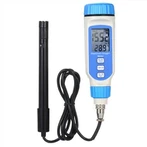
(1) Classification according to the application occasion: it can be divided into pen type pH meter, portable pH meter, laboratory pH meter and industrial pH meter, etc. The pen-type pH meter is mainly used to replace the function of acid-base test paper, and has the characteristics of low precision and convenient use. Portable pH meters are mainly used for on-site and field measurements, requiring high precision and perfect functions.
(2) Classification according to the accuracy of the instrument: it can be divided into 0.2, 0.1, 0.02, 0.01 and 0.001. The smaller the number, the higher the accuracy.
(3) Classification according to the reading indication: it can be divided into two types: pointer type and digital display type. Pointer pH meters are rarely used nowadays, but pointer meters can display the continuous change process of data, so they are still used in titration analysis.
(4) Classification according to the type of components: it can be divided into transistor type, integrated circuit type and single-chip microcomputer type. Nowadays, more microcomputer chips are used, which greatly reduces the size of the instrument and the cost of a single machine; but the development cost of the chip is very expensive.
2. Laboratory pH meter: Laboratory pH meter is a desktop high-precision analytical instrument that requires high precision and full functions, including printout, data processing, etc.
3. Industrial pH meter: Industrial pH meter is used for continuous measurement of industrial processes. It not only has measurement and display functions, but also has alarm and control functions, as well as installation, cleaning, anti-interference and other issues.
The function of pH meter
1. Economical pen acidity meter dual screen can display temperature and acidity value at the same time;
2. Temperature compensation function;
3. Three-point automatic calibration is easy to operate;
4. With IP67 waterproof function;
5. Automatic compensation/identification of solution temperature to avoid correction errors;
6. Data retention function;
7. Automatic shutdown can be lifted.