Classification of voltage test pens
According to the level of the measured voltage:
High-voltage measuring pen: used for 10kv and above projects, and is a daily testing tool for electricians;
Low-voltage measuring pen: used for the detection of charged objects with a line voltage of 500V and below.
Weak current testing pen: used for testing electronic products, the general test voltage is 6v--24v. For ease of use, the tail of the electric pen often has a lead wire with a clip.
According to the way of contact:
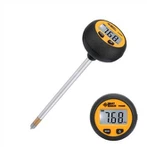
Contact test pen: A detection tool that obtains electrical signals by contacting a charged body. Usually the shape is a flat-blade screwdriver, which can also be used as a test pen and a flat-blade screwdriver; it is a pen-type, which directly displays the measurement data on the LCD window.
Inductive test pen: It adopts inductive test without physical contact, and can check the voltage on the control line, conductor and socket or check the open circuit position along the wire. The personal safety of testing personnel can be guaranteed to the greatest extent.
The specific instructions are as follows:
A. When the electric pen is used to detect whether a certain conductor is live or neutral, the current passing through the electric pen (that is, the current through the human body) I = the total voltage U applied at both ends of the electric pen and the human body, divided by (/equivalent Fraction line) measure the total resistance R between the electric pen and the two ends of the human body.
B. When measuring the live wire, the lighting circuit has a voltage of about U=220V between the live wire and the ground. The resistance of the human body is generally small, usually only a few hundred to a few thousand ohms, and the internal resistance of the test pen is usually about several megohms. The current of the test pen (that is, the current passing through the human body) is very small, usually less than 1 milliampere. When such a small current passes through the human body, it will not harm people, and when such a small current passes through the neon bulb of the test pen, the neon bulb will will shine.
C. When measuring the zero line, U=0, I=0, that is, no current passes through the neon bulb of the test pen, and of course the neon bulb does not emit light. In this way, we can judge whether the live line or the neutral line is based on whether the neon bulb glows.