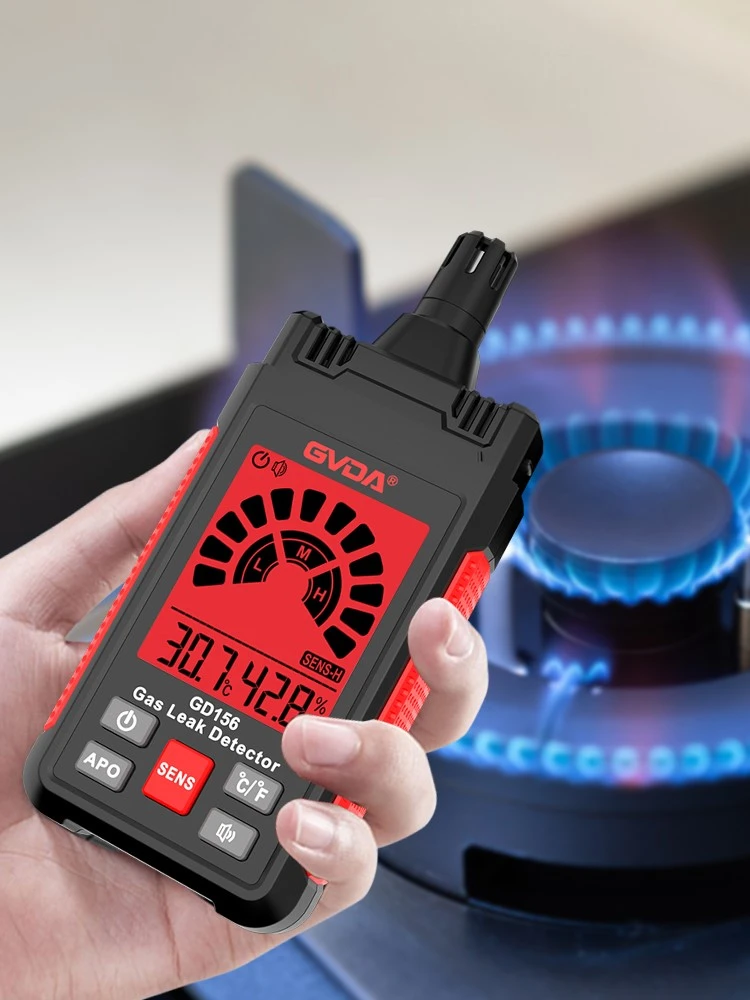
CO electrochemical sensor detection principle of gas detector
The electrochemical carbon monoxide gas sensor adopts a closed structure design, and its structure is composed of electrodes, filters, gas-permeable membranes, electrolytes, electrode lead wires (pins), and housings.
The carbon monoxide gas sensor is used in conjunction with the alarm and is the core detection element in the alarm. It uses constant potential electrolysis as the basic principle. When carbon monoxide diffuses to the gas sensor, its output terminal generates a current output, which is provided to the sampling circuit in the alarm, and plays a role in converting chemical energy into electrical energy. When the gas concentration changes, the output current of the gas sensor also changes proportionally, and the output is converted and amplified by the intermediate circuit of the alarm to drive different actuators to complete the detection and alarm functions of sound, light and electricity, and corresponding The control devices together constitute an environmental detection or monitoring alarm system.
When the carbon monoxide gas diffuses to the surface of the working electrode through the gas holes on the shell through the gas-permeable membrane, under the catalysis of the working electrode, the carbon monoxide gas is oxidized on the working electrode. Its chemical reaction formula is:
CO+H2O→CO2+2H++2e-
The H+ ions and electrons generated by the oxidation reaction on the working electrode are transferred to the counter electrode at a certain distance from the working electrode through the electrolyte, and undergo a reduction reaction with oxygen in the water. Its chemical reaction formula is:
1/2O2+2H++2e-→H2O
Therefore, a reversible oxidation-reduction reaction occurs inside the sensor. Its chemical reaction formula is:
2CO+2O2→2CO2
This reversible oxidation-reduction reaction always occurs between the working electrode and the counter electrode, and generates a potential difference between the electrodes.
However, since the reactions occurring on the two electrodes will polarize the electrodes, it is difficult to maintain a constant inter-electrode potential, thus limiting the detectable range of the carbon monoxide concentration.
In order to maintain a constant potential between electrodes, we added a reference electrode. In the three-electrode electrochemical gas sensor, the output terminal reflects the potential change between the reference electrode and the working electrode. Since the reference electrode does not participate in the oxidation or reduction reaction, it can keep the potential between the electrodes constant. (That is, constant potential), the change of potential at this time is directly related to the change of the same carbon dioxide concentration. When the gas sensor produces an output current, its magnitude is proportional to the concentration of the gas. The concentration of carbon monoxide can be detected by measuring the output current of the sensor with an external circuit through the electrode lead wire, and it has a wide linear measurement range. In this way, the detection and monitoring of carbon monoxide gas can be realized by externally connecting the signal acquisition circuit and the corresponding conversion and output circuit to the gas sensor.