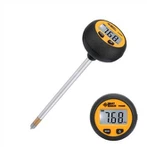
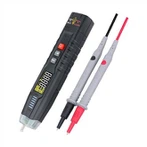
Coating Thickness Gauge Definition and F and NF Probe Areas of Application Officially Revealed
The coating thickness gauge can non-destructively measure the thickness of non-magnetic coatings (such as aluminum, chromium, copper, enamel, rubber, paint, etc.) and non-magnetic coatings on magnetic metal substrates (such as steel, iron, alloys and hard magnetic steel, etc.) The thickness of the non-conductive coating (such as enamel, rubber, paint, plastic, etc.) on the metal substrate (such as copper, aluminum, zinc, tin, etc.). Coating thickness gauge has the characteristics of small measurement error, high reliability, good stability and easy operation. It is an indispensable testing instrument for controlling and ensuring product quality. It is widely used in manufacturing, metal processing industry, chemical industry, Commodity inspection and other inspection fields.
Features of coating thickness gauge
It adopts a dual-function built-in probe to automatically identify iron-based or non-ferrous base materials and select the corresponding measurement method for measurement.
Ergonomically designed dual-display structure allows measurement data to be read at any measurement position.
Using the mobile phone menu function selection method, the operation is very simple.
The upper and lower limit values can be set. When the measurement result exceeds or meets the upper and lower limit values, the instrument will issue a corresponding sound or flashing light prompt.
It is extremely stable and can usually be used for a long time without correction.
Technical specifications
Measuring range: 0~2000μm,
Power supply: Two AA batteries
Standard configuration
The difference between FN in coating thickness gauge
F stands for ferrous ferromagnetic substrate. The F-type coating thickness gauge uses the principle of electromagnetic induction to measure non-ferromagnetic coatings and coatings on ferromagnetic metal substrates such as steel and iron, such as paint, powder, plastic, and rubber. , synthetic materials, phosphate layer, chromium, zinc, lead, aluminum, tin, cadmium, porcelain, enamel, oxide layer, etc.
N stands for Non-ferrous non-ferrous substrate. The N-type coating thickness gauge adopts the eddy current principle; it uses eddy current sensors to measure enamel, rubber, paint, plastic layers, etc. on copper, aluminum, zinc, tin and other substrates.
The FN type coating thickness gauge adopts both the electromagnetic induction principle and the eddy current principle. It is a two-in-one coating thickness gauge of F type and N type. See above for usage. Magnetic thickness gauge with an F probe;