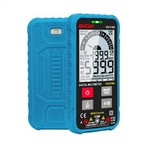
Common Faults and Cause Analysis of Clamp Meters
Clamp on ammeter is an indispensable instrument in the field of power and electronic measurement, which can directly measure the current value in the circuit without cutting off the circuit. However, due to various reasons, clamp ammeters may encounter various faults during use. This article will provide a detailed analysis of common faults in clamp current meters and explore their possible causes, in order to provide reference for relevant technical personnel.
The basic structure and working principle of clamp ammeter
The clamp ammeter mainly consists of a current transformer, a measuring mechanism, and an indicating device. Its working principle is based on the law of electromagnetic induction. When the measured current passes through the clamp of the clamp ammeter, a magnetic field is generated inside it, which in turn induces current in the measuring mechanism. By measuring the magnitude of this induced current, the value of the measured current can be indirectly obtained.
Common faults and cause analysis
No indication or inaccurate indication
(1) Reason for malfunction:
a. Low battery level: Clamp on ammeters usually require built-in battery power supply. If the battery level is low, it may cause the instrument to malfunction or the indication to be inaccurate.
b. Improper selection of measurement range: If the selected measurement range does not match the magnitude of the measured current, it may also result in inaccurate indication.
c. Poor contact between the jaws: Poor contact between the jaws and the measured wire can cause loss of magnetic flux, which in turn affects the measurement results.
d. Coil malfunction: If the coil of the clamp ammeter malfunctions, such as wire breakage, short circuit, etc., it can also lead to inaccurate measurement.
(2) Solution:
a. Check the battery level and replace the battery in a timely manner.
b. Select the appropriate measurement range to ensure it matches the magnitude of the measured current.
c. Clean the jaws to ensure good contact with the tested wire.
d. Check and repair coil faults, such as replacing damaged coils.