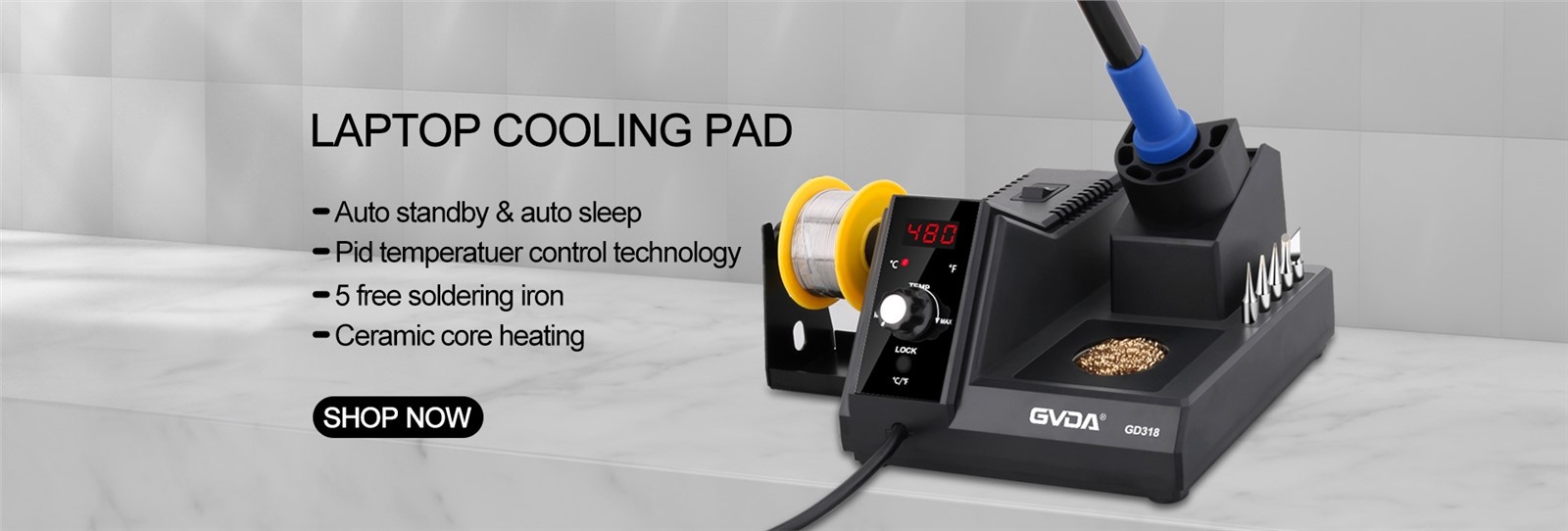
Comparison between soldering station and electric soldering iron
A soldering station is a manual tool commonly used in electronic soldering processes. It melts two devices by applying heat to the solder (usually tin wire).
At present, in order to protect the environmental requirements, many countries have banned the use of lead-containing solder wires, which increases the soldering temperature, because the melting point of lead-free tin wires is higher than that of lead-tin wires. There are higher requirements for temperature compensation, temperature rise and temperature return speed of soldering station. Temperature rise and temperature return speed are an important indicator to determine production efficiency, so choosing a better soldering station depends on its temperature control ability . This is the huge gap with the traditional soldering iron.
There are many ways to control the temperature, but the simplest one is the adjustable power control. The soldering station controls the temperature by quickly transferring heat to the workpiece through the soldering iron. Another method is to use a thermostat to control the temperature by turning the power on or off. There is also a more advanced solution, which uses an integrated chip to detect the temperature of the soldering iron tip, and then adjusts the power of the thermostat to control the temperature. When the temperature of the soldering iron tip is lower than the set temperature, the host is turned on and supplies power to the thermostat to generate heat. When the temperature of the soldering iron tip is higher than the preset temperature, the host is turned off and stops heating.
Soldering stations are used in a wide range of applications, ranging from common electronic appliance repairs to electronic integrated circuits and chips. Soldering stations are used as welding tools, but they are most commonly used for soldering of PCB circuit boards in electronics factories.
Function:
Digital display temperature: easy to adjust.
Sleep function: energy saving, prolonging the life of the soldering iron tip.
Password lock temperature: prevent workers from changing the temperature setting at will.
Anti-static function: prevent precision chip welding from being broken down by static electricity.
Compared with the difference between electric soldering iron:
1. Compared with the efficiency, the efficiency of the constant temperature soldering station is relatively high, and the thermal efficiency can reach about 80%. Generally, 50% of the electric soldering iron is not bad;
2. Compared with energy consumption, the energy consumption of the constant temperature soldering station is relatively low, because when the adjusted temperature is reached, the heating is not performed, and the corresponding energy consumption is lower, that is to say, the same welding effect, the soldering station consumes less electricity;
3. Compared with the return temperature, the return temperature of the soldering station is faster, and the work efficiency of the corresponding workers is higher;
4. Compared with the service life of consumables, the temperature of the soldering station is controlled and will not rise infinitely, so the service life of the soldering iron tip and the service life of the heating core are relatively high;
5. Safety comparison, the handle voltage of the soldering station is only AC 24 volts, which is a safe voltage, and generally there will be no electric shock;
6. Compared with anti-static, the soldering station has the function of removing static electricity, but the electric soldering iron generally does not.